Locations:





CD36 loss-of-function variant accounts for large portion of risk in this population
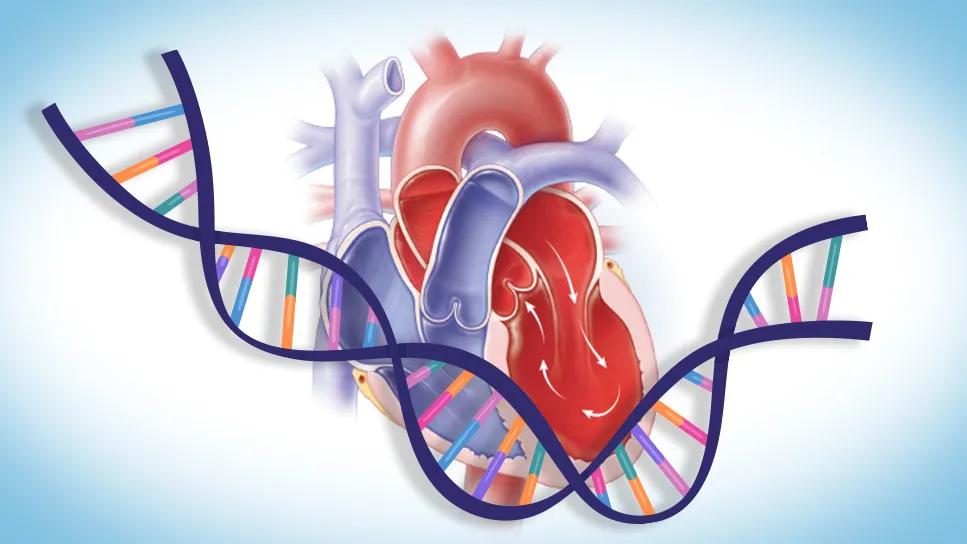
Image content: This image is available to view online.
View image online (https://assets.clevelandclinic.org/transform/a79946e1-024f-43f4-899a-7eab861880ec/dilated-cardiomyopathy-dna)
illustration of a human heart with DNA double helix
A recent study leveraging large-scale genomic data has identified a common, ancestry-specific genetic variant that significantly increases the risk of dilated cardiomyopathy (DCM) in individuals of African genetic ancestry (AFR). This variant, a nonsense mutation (rs3211938) in the CD36 gene, is common in AFR populations (where it is present in 17% of individuals) but is virtually absent in individuals of European ancestry (EUR).
Advertisement
Cleveland Clinic is a non-profit academic medical center. Advertising on our site helps support our mission. We do not endorse non-Cleveland Clinic products or services. Policy
This discovery offers a long-sought mechanistic explanation for the disproportionately high burden of DCM seen in Black patients, revealing a novel pathway to heart failure rooted in impaired myocardial energy metabolism rather than direct damage to the heart’s contractile machinery.
The findings are notable because this single variant accounts for approximately 20% of the excess risk for incident DCM found in AFR individuals compared with EUR individuals. “The amount of risk for dilated cardiomyopathy in people of African ancestry that’s accounted for by this one genetic variant is at least as much as is accounted for by major risk factors like diabetes or chronic kidney disease,” says Krishna Aragam, MD, senior author of the study, which was published in Nature Genetics (2025;57:2682-2690).
“While further work is needed to define the exact ways in which these findings will impact practice, they should meaningfully inform clinical suspicion and diagnostic evaluation for cardiomyopathy and heart failure in patients with African ancestry,” adds Dr. Aragam, a cardiologist who directs the Haslam-Bailey Family Section of Cardiovascular Genomics and Precision Medicine and the Center for Cardiovascular Genomics and Data Sciences, both at Cleveland Clinic.
DCM is a leading cause of heart failure with reduced ejection fraction and the most frequent indication for heart transplantation. Historically, Black individuals have been reported to be about twice as likely to develop DCM as white individuals.
Advertisement
“In prior research, this disparate risk has not been fully explained by differences in traditional cardiovascular risk factors or differences in access to care,” Dr. Aragam notes. “So it has long been suspected that other factors, perhaps relating to ancestral origin, may be at play. But we needed enough genetic data from this particular population to properly explore this question.”
That degree of data became available through the genetically heterogeneous Department of Veterans Affairs’ Million Veteran Program biobank, which Dr. Aragam and his multicenter coinvestigators leveraged to identify genetic determinants of DCM specific to AFR individuals.
Among the 95,606 AFR participants in the Million Veteran Program, 1,802 had DCM, for a prevalence of 1.9%, nearly twice as high as the 1.0% DCM prevalence among the 364,120 EUR participants.
Within the Million Veteran Program’s AFR cohort, the researchers conducted a genome-wide association study for DCM among these 1,802 DCM cases and the remaining 93,804 control participants. The analysis identified a robust association signal on chromosome 7 within the CD36 gene. Subsequent investigation focused on the likely causal variant in this region: rs3211938.
The rs3211938 variant is a nonsense mutation that introduces a premature stop codon in the CD36 protein, effectively causing a loss of function. The risk allele has a frequency of 17% in AFR populations, in stark contrast to its rarity in EUR populations (< 0.1%).
The association between the rs3211938 variant and DCM was successfully replicated in four independent cohorts, including the Penn Medicine Biobank. Key results included the following:
Advertisement
The CD36 protein is a crucial scavenger receptor responsible for transporting long-chain fatty acids into cardiomyocytes. The normally functioning heart relies primarily on fatty acid oxidation for energy, but heart failure is characterized by reduced fatty acid utilization.
In another arm of their research reported in the Nature Genetics paper, the researchers conducted experiments in human induced pluripotent stem cell-derived cardiomyocytes. These showed that CD36 loss of function caused by the rs3211938 variant impairs lipid uptake, compromising the energy supply needed for heart muscle contractility.
“Most known genetic drivers of DCM affect the contractile apparatus, the sarcomere,” Dr. Aragam notes. “CD36 operates upstream of that machinery. This mutation impairs the heart’s fuel supply, representing an entirely different mechanism.”
The researchers conclude that their study establishes a clear link between a common, high-impact CD36 loss-of-function variant and increased DCM risk in individuals of African descent. “Having one copy of the variant conferred nearly a 30% increased risk, and having two copies conferred nearly a 300% increased risk,” Dr. Aragam observes. “That’s a level of risk much larger than expected for something this common.”
He adds that the findings mean this variant “should be very much top of mind for clinicians when working up patients with African ancestry for cardiomyopathy and heart failure.” However, no clinical test is yet available for this CD36 variant, although Dr. Aragam says that may change before long.
Advertisement
Indeed, developing a clinical test for the variant is something that Cleveland Clinic’s new Center for Cardiovascular Genomics is actively exploring, as are others. The center is also looking to define the natural history and clinical course of carriers of the variant.
“Knowledge of this CD36 gene variant reframes how we think about unexplained cases of cardiomyopathy in some patients and opens the door to new approaches for evaluating and managing heart failure,” Dr. Aragam concludes. “Our work at Cleveland Clinic will now focus on translating these insights into meaningful advances for patients, from improving early detection of heart failure to developing therapies that target this newly uncovered energetic pathway.”
“This study adds a piece to the puzzle of genetic risk factors for cardiomyopathy, particularly in populations that historically have not been proportionally included in genetic research,” adds W. H. Wilson Tang, MD, Research Director for Heart Failure and Cardiac Transplantation in Cleveland Clinic’s Department of Cardiovascular Medicine. “The findings have the potential to help develop innovative strategies to identify and treat at-risk groups to prevent heart failure.”
Advertisement
Advertisement

After optimized medical and device therapy, is there a role for endocardial-epicardial VT ablation?

Cleveland Clinic and Cleveland Clinic Abu Dhabi expand access to potentially curative care

Study finds exome sequencing can uncover additional diagnoses after nondiagnostic panel testing

Durability findings propel potential one-time treatment approach to phase 1b testing

Life-changing gene therapy is currently under FDA review
GenT framework aims to improve drug development with focus on entire genes, not individual mutations

Experts discuss advances in precision medicine, the value of collaborative care and more

Introducing Krishna Aragam, MD, head of new integrated clinical and research programs in cardiovascular genomics
 Search