Locations:


Physical, occupational and speech therapists will provide state-of-the-art outpatient care
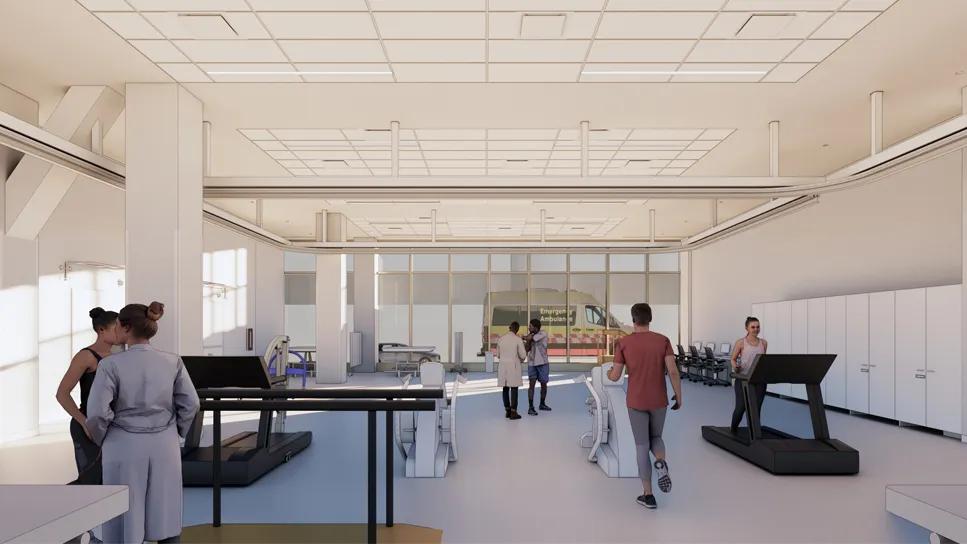
Image content: This image is available to view online.
View image online (https://assets.clevelandclinic.org/transform/225d269a-7d6e-487e-bd54-f97ec0493f86/new-neuro-bulding-rehabilitation)
rendering of new rehab space
Last year, Cleveland Clinic Rehabilitation and Sports Therapy logged more than 1 million patient visits at its 45 locations. In 2027, the health system will open a state-of-the-art space for physical, occupational and speech therapy as part of the new 1-million-square-foot Neurological Institute building. There, neurological providers and services will work together under one roof to diagnose, treat and research conditions of the brain, nervous system and spine.
Advertisement
Cleveland Clinic is a non-profit academic medical center. Advertising on our site helps support our mission. We do not endorse non-Cleveland Clinic products or services. Policy
“My team and I are excited to shape the future of rehabilitative therapy and patient care in collaboration with our neurology colleagues,” says Maureen Ivec, PT, DPT, NCS, Clinical Rehab Manager at Cleveland Clinic Main Campus.
Outpatient physical, occupational and speech therapy will be offered on the first floor of the building. The space will feature a large, open therapy gym as well as private spaces for sessions with patients. However, care will begin before patients even enter the area, when they check in digitally in the building’s assessment center on the ground floor and complete a series of neuroperformance modules to assess their gait, balance, voice and other functions.
“We will have direct access to robust data collected in the assessment center that’s not part of our current practice,” says Dr. Ivec.
Having access to this data before appointments is a gamechanger, says Kathy Szirony, PT, DPT, Outpatient Rehabilitation Manager in the Neurological Institute.
“As a physical therapist, it will be great to see a patient walk across the room on my screen and get a sense of how they are moving before I actually go to the lobby to meet them,” Dr. Szirony says. “Our speech therapists will have the same advantage, listening to how a patient speaks on the computer before they meet them in the lobby. Occupational therapists will have information about finger dexterity. This will allow our outpatient therapy team to have objective data at their fingertips and speed up the evaluation process, allowing them to initiate treatment interventions quicker.”
Advertisement
In the rehabilitation space itself, patients will work with specialty-trained therapists using advanced equipment and technologies that Drs. Ivec and Szirony and their peers helped select.
“I always enjoy going to our annual physical therapy conference and seeing the latest innovations on the market,” says Dr. Szirony. “It was a once-in-a-lifetime experience to be involved in a project of this magnitude and help choose technology for the building that will benefit our patients.”
The team also collaborates with research colleagues on equipment and innovation.
“Having research right here in the building will allow us to continue shaping and testing new technologies well into the future,” Dr. Szirony adds.
The rehabilitation technology encompasses several categories of equipment, including:
Mobility and Safety Support. The area will feature the Artech ZeroG Gait and Balance System, which is an overhead robotic body-weight support system, and the Artech 3D support system, which offloads some of the patient’s weight and allows for multidimensional movement.
“I’m excited for the opportunity to challenge patients moving forward, backward and diagonally as they simulate their daily activities of living while remaining safe in the harness system,” says Dr. Ivec.
Other equipment will include a Guldmann ceiling lift and the Woodway LokoStation specialized gantry and body-weight support system for gait-impaired patient rehabilitation.
Gait and Balance Training. Treadmills in the space will include the BalanceTutor 4D perturbation-based system. “The patient is in a harness so if they are thrown off balance they remain safe while learning how to react to trips and slips,” says Dr. Ivec.
Advertisement
In addition, patients will use the LiteGait system, which combines a partial body-weight support device with a specialized GaitKeeper treadmill, and a functional electric stimulation bicycle that uses low-level electrical impulses to activate paralyzed or weakened muscles.
Stair trainers will include the Biodex Reactive Step Trainer that combines gait and perturbation-based balance training, and the Dynamic Stair Trainer to help patients recover lower-limb mobility, balance and gait.
“We chose the Dynamic Stair Trainer because it can turn from a set of stairs into parallel bars and it’s mobile, so we can move it around for use anywhere in our therapy areas,” says Dr. Ivec.
Augmented Reality. One of the highlights of the rehabilitation area will be the Strolll augmented reality digital therapeutics platform, which the health system has been using in other outpatient facilities for nearly a year. “Through a Cleveland Clinic Innovations partnership with the company, we were able to provide feedback on applications, and Strolll made some adaptations to their games,” says Dr. Ivec. “We’ve seen a direct impact on our use in the clinic.”
Patients also will use the C-Mill interactive rehabilitation treadmill, which incorporates augmented and virtual reality.
Szirony says she is excited to witness the full potential of these technologies when they are used in combination. For example, therapists plan to combine the Artech ZeroG 3D lift with virtual reality. The team collaborated with vendors on an application to create a virtual grocery store and check-out counter.
Advertisement
“That will help our patients simulate how they manage and navigate in real-world environments,” says Dr. Szirony.
Dr. Ivec looks forward to incorporating all of the innovative technologies into outpatient clinical practice.
“We have the opportunity to enhance people’s lives with these technologies,” she says. “Anything that safely provides a higher level of challenge will help our patients’ nervous systems adapt and change and better prepare them for challenging situations at home and in the community.”
Dr. Szirony says she believes the technologies in the soon-to-open outpatient rehabilitation space — and throughout the new building — are unique to the region.
“To offer all of this in a collaborative setting that supports clinical care, research and innovation — that’s the piece that will set us apart,” she says.
Advertisement
Advertisement

PTs’ roles as educators and translators make them a natural fit for informatics
Physical therapy before surgery is intended to optimize outcomes after surgery
Recognizing mobility as a human right is instrumental to change

Early diagnosis, specialized assessment and high-frequency motor-based therapy can improve outcomes
Pilot program addresses extended wait times for evaluation

Infants with > 30° of cervical tightness were also more likely to be younger at evaluation

Exploring the role of caregiver education and objective feedback on speech and language outcomes

Milestone case report expands understanding of infectious risks for those on immunomodulatory therapies
 Search