Locations:





History of laparoscopy with morcellation should inform differential
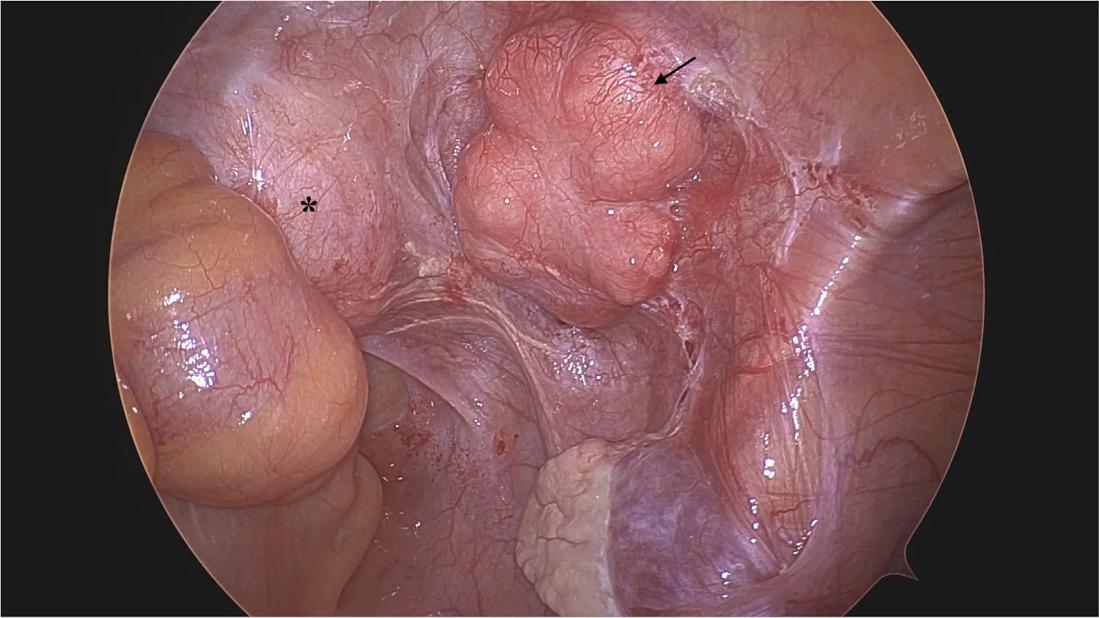
Image content: This image is available to view online.
View image online (https://assets.clevelandclinic.org/transform/0ebd88ae-20f7-4367-8be4-02d1d0a89a06/post-hysterectomy-parasitic-myoma)
Intra-operative right retroperitoneal pelvic mass
Image above: A right retroperitoneal pelvic mass (see arrow) was positioned lateral to the cervix (asterisk).
Advertisement
Cleveland Clinic is a non-profit academic medical center. Advertising on our site helps support our mission. We do not endorse non-Cleveland Clinic products or services. Policy
When imaging indicated a 6 cm ovarian mass in a woman with a history of both fibroids and breast cancer, the patient was referred to gynecologic oncology and surgery was scheduled. Surgeons at Cleveland Clinic in Florida performed a bilateral oophorectomy and excised the 6 cm mass from the rightretroperitoneumas well as two additional solid masses.
Although the patient, 51, was asymptomatic, her breast cancer history and the size of the larger tumor caused concern for malignancy. Pathology confirmed that all three masses were parasitic leiomyomas — benign uterine fibroids.
In this case at Cleveland Clinic in Florida, the patient years earlier had undergone laparoscopic supracervical hysterectomy and bilateral salpingectomy with power morcellation to remove fibroids.
Parasitic leiomyomas are rare but have been associated with prior laparoscopic fibroid surgery involving uncontained power morcellation. As minimally invasive gynecologic surgery became more popular in the late 1990s, surgeons often turned to power morcellation to remove tissue through small incisions. However, in the 2010s, concerns arose over the possibility of tissue dissemination during morcellation used to treat fibroids.
Cleveland Clinic physician Adria Suarez Mora, MD, and Taylore King, MD, published their case in the Journal of Minimally Invasive Gynecology.
The case offers some reminders for clinicians.
Containment remains important when laparoscopy with power or manual morcellation is used.
A 2022 study published in Obstetrics & Gynecology found that in the four years after the FDA's 2014 warning about the risk of tissue dissemination with power morcellation, use of power morcellation fell dramatically; still, nearly 85% of such procedures were done without containment.
Advertisement
Although there was no cancerous dissemination in the Cleveland Clinic case, "even these benign cells can have consequential outcomes and result in further surgeries that might not have been needed had these specimens been contained in the first place," says Dr. King.
Whenever possible in cases of pelvic masses, clinicians should ascertain whether the patient has a history of power morcellation. In the case at Cleveland Clinic, parasitic leiomyoma related to prior hysterectomy had not been included in the differential diagnosis.
Knowledge of prior morcellation may affect patient counseling and/or surgical planning.
"This patient was sent to me for a solid complex ovarian mass, and I'm a cancer surgeon, and so she was told that she probably had cancer," says Dr. Suarez Mora.
Had the patient been younger and without a cancer history, the oophorectomy might not have been needed, Dr. Suarez Mora says. "Given this patient's history of breast cancer, removal of the ovaries made sense. But it's good to have some awareness if a person has had morcellation in the past so that the situation might be approached appropriately."
Finally, says Dr. Suarez Mora, younger physicians and trainees should be made aware of the issues around morcellating without containment and its possible outcomes. Although power morcellation is used less frequently these days, it was not long ago that it was more common.
"Patients are still presenting with these complications of morcellation. And some of our trainees may never train in an era where they know what morcellation is."
Advertisement
Advertisement

Struma ovarii can give rise to uncommon malignancy

Akron General project highlights the benefits of doula partnerships

Change eliminates waste associated with dual-field approach
Researchers compare two image modes in detecting left ventricular remodeling

Nutrition and cooking program supports maternal-infant health
New moniker brings clarity to this complex condition

A device implanted at the ankle joins the lineup of third-line treatments
Aiming for earlier detection of endometrial cancer in an era of increasing incidence
 Search