Locations:





Lower threshold expanded revascularization candidacy without raising early complication rates
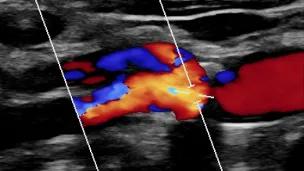
Image content: This image is available to view online.
View image online (https://assets.clevelandclinic.org/transform/818fa4fa-6b8d-4b4a-bb27-0607be15ab34/26-HVI-9007811-CQD-scan1)
Black-and-white scan with red and blue highlights
For clinicians managing atherosclerosis, asymptomatic carotid stenosis remains one of the hardest treatment decisions. When does stroke prevention justify procedural risk in a patient who feels well?
Advertisement
Cleveland Clinic is a non-profit academic medical center. Advertising on our site helps support our mission. We do not endorse non-Cleveland Clinic products or services. Policy
Society for Vascular Surgery guidance supports revascularization in selected asymptomatic patients with more than 70% stenosis and reasonable life expectancy. Yet many high-volume centers, including Cleveland Clinic, have historically used a more conservative 80% threshold.
While this approach may have spared some patients unnecessary procedures, it also raised concern that others with 70%-80% stenosis might remain under surveillance despite potentially benefiting from earlier treatment.
Findings from the recent CREST-2 trial caused the Vascular Surgery Department at Cleveland Clinic to rethink its criteria, says Cleveland Clinic vascular surgeon Ali Khalifeh, MD.
“Even among patients receiving the best medical therapy for high-grade asymptomatic carotid stenosis, the annual stroke risk was about 1.7%,” he says. “Over five years, that approaches 10%, which is clinically significant.”
As a result, in late 2024, Cleveland Clinic’s vascular surgeons agreed to shift carotid duplex criteria to a 70% threshold, aligning with Intersocietal Accreditation Commission recommendations.
The team anticipated that the revised criteria would identify more asymptomatic patients with severe disease and lead to higher carotid revascularization volume. One year after implementation, procedure volume had increased modestly without a corresponding rise in short-term complications. These findings were presented at the 2026 Vascular Annual Meeting.
“The revised imaging threshold did not automatically trigger intervention,” says Cleveland Clinic vascular surgery resident Nathan Reinert, MD, who presented the findings. “Treatment decisions remained individualized.”
Advertisement
Cleveland Clinic surgeons continue to weigh age, frailty, dialysis dependence, heart failure, pulmonary disease and expected survival before recommending carotid endarterectomy or stenting in patients with stenosis of 70% or more. Revascularization is recommended at 80% stenosis if life expectancy is more than three years.
In a quality review comparing the year before the transition with the year after it, investigators used Vascular Quality Initiative analytics and internal dashboards to assess procedure volume and in-hospital outcomes.
Key findings included:
Advertisement
Despite higher treatment volume, in-hospital rates of stroke, myocardial infarction, death and return to the operating room remained low after the transition.
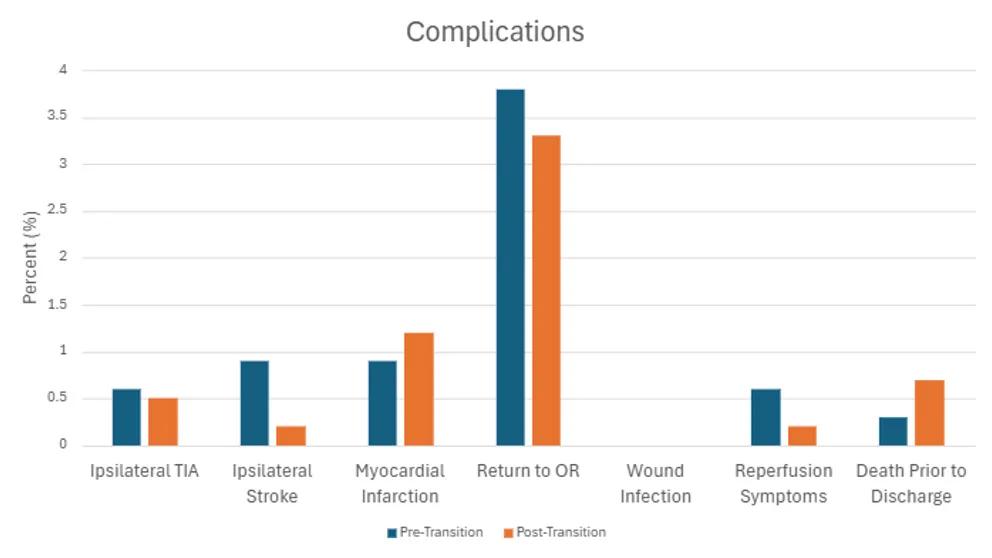
Image content: This image is available to view online.
View image online (https://assets.clevelandclinic.org/transform/f44773ae-b7b6-4249-a657-7ace7ca06fa6/26-HVI-9007811-CQD-chart)
30-day outcomes before and after transition to > 70% revascularization threshold for carotid artery stenosis.
“The question for us was whether lowering the threshold from 80% to 70% would put more patients at risk,” Dr. Khalifeh says. “Based on these early results, the answer appears to be no.”
Lowering the duplex threshold to 70% may help identify more patients who could benefit from revascularization without compromising short-term safety, he says.
Cleveland Clinic continues to track vascular surgery outcomes through long-term patient follow-up and participation in the Society for Vascular Surgery’s Vascular Quality Initiative, using those data to drive ongoing quality improvement.
In 2026, Cleveland Clinic became one of a select group of institutions to earn the three-star (highest rated) Commitment to Vascular Quality Improvement Award for eight consecutive years or more.
Advertisement
Advertisement

First-ever transcarotid artery revascularization trial with no strokes or device-related deaths
Insights from the Cleveland Clinic experience and a multispecialty alliance
A look at where TCAR and transfemoral carotid stenting are likely headed
Retrospective findings from an executive health program spur interest in broader studies
JACC review calls for CMS to update coverage decision

Collaborative citywide initiative reshapes protocols to boost cardiac arrest survival
For severe cases, complete unroofing of the bridge is imperative

Elevated levels of the gut microbial metabolite predict prevalence and adverse outcomes in community-based study
 Search