Locations:





How computational tools and personalized biomechanics can improve keratoconus detection, ectasia risk assessment and surgical outcomes

Image content: This image is available to view online.
View image online (https://assets.clevelandclinic.org/transform/0af8b0b3-75d0-49f3-87a8-a43e122c6030/addressing-keratoconus)
Girl's eye
By William J. Dupps Jr., MD, PhD
Advertisement
Cleveland Clinic is a non-profit academic medical center. Advertising on our site helps support our mission. We do not endorse non-Cleveland Clinic products or services. Policy
Keratoconus is a leading cause of reduced quality of life due to vision loss. Stabilizing treatment (corneal cross-linking) is available. However, gaining the most benefit from this treatment requires understanding keratoconus and detecting it as early as possible.
This is greatly important for refractive surgery clinics, where even with all the preoperative data we get from sophisticated devices, we still encounter inexplicable cases of postoperative corneal ectasia.
We have 3D tomography, epithelial mapping and other advanced technologies for preoperative workup. We have femtosecond and excimer lasers and algorithms for submicron precision in treatment. However, between those steps, there is a precision gap in surgical planning.
Right now, the state-of-the-art tool for laser refractive surgery planning is a regression formula with only one variable (the refractive error you want to treat). You work backwards from your historical outcomes, and you adjust. There also are various decision trees and nomograms for other refractive surgery procedures, yet there is not one unifying clinical decision tool.
Ectasia risk assessment also is fragmented. We have multiple devices looking at multiple variables — topography, thickness, D score and others — all assessing the same risk in different ways.
Our current paradigms for optimizing outcomes are retrospective, probabilistic and population-based. Our goal is to shift towards a more prospective approach, one that is more deterministic (less probability-based) and personalized.
Advertisement
One approach that we’re working on at Cleveland Clinic Cole Eye Institute is finite element modeling. This structural engineering method creates a digital twin for interrogation of shape and mechanical behavior under stress.
Essentially, a structure is broken into smaller elements. You define the physics of those elements, which may be different depending on their location in the structure. And then you compute a global solution that’s iterative, where you mathematically solve the stress-strain equations across the whole structure.
At that point, you introduce a potential surgery to the cornea and repeat the iteration to account for the effects of the surgery. This produces a different shape and structural loading scenario than the cornea had before.
In a 2009 study, a postdoctoral fellow and I simulated LASIK surgery on a virtual version of an eye, built from Scheimpflug tomography data. We modeled it and changed only one thing, the preoperative strength of the cornea. We found that, after LASIK, the stiffer cornea had a slight flattening effect from the strain patterns. (The periphery tended to bulge slightly.) That flattening produced a slightly more hyperopic effect than intended, an overcorrection. The weaker cornea had the opposite effect after LASIK. The center bulged and periphery flattened slightly, resulting in myopic undercorrection.
This tendency of the cornea to flatten when stiffened is precisely what explains flattening in corneal cross-linking. Ours was the first model to explain the phenomenon.
Advertisement
We also showed that the phenomenon is sensitive to intraocular pressure (IOP). The load makes a difference. Increasing IOP favors flattening in stiff corneas and steepening in weaker ones.
Our early study merely looked at the overall strength of the cornea. We did not incorporate how corneal strength varies from front to back and side to side. Given that there’s asymmetry in the cornea, we expect even more person-to-person variation in responses after an ablation.
All of this shows that when corneal properties vary by individual, those individual properties impact the outcomes of laser vision correction.
We now need to make these findings usable in refractive surgery clinics. At the Cole Eye Institute, we are working on building a computational tool that extracts tomography data from any tomography device, reconstructs a 3D model and uses it to create a finite element mesh.
We have to specify the material properties (initially assumed to be the same for every eye). We can import additional personalized data, such as the refractive error or axial length of the eye to produce a whole-eye model, incorporating the boundary conditions of a real eye at the sclera and the limbus. Then, we input the IOP we measured in clinic, which loads the structure.
Next, we are prompted to simulate a procedure, selecting LASIK, cross-linking, keratorefractive lenticule extraction (KLEx) or other choices from a drop-down menu. We can specify the depth, arc length and other geometric variables, just like we do on a treatment device interface.
Advertisement
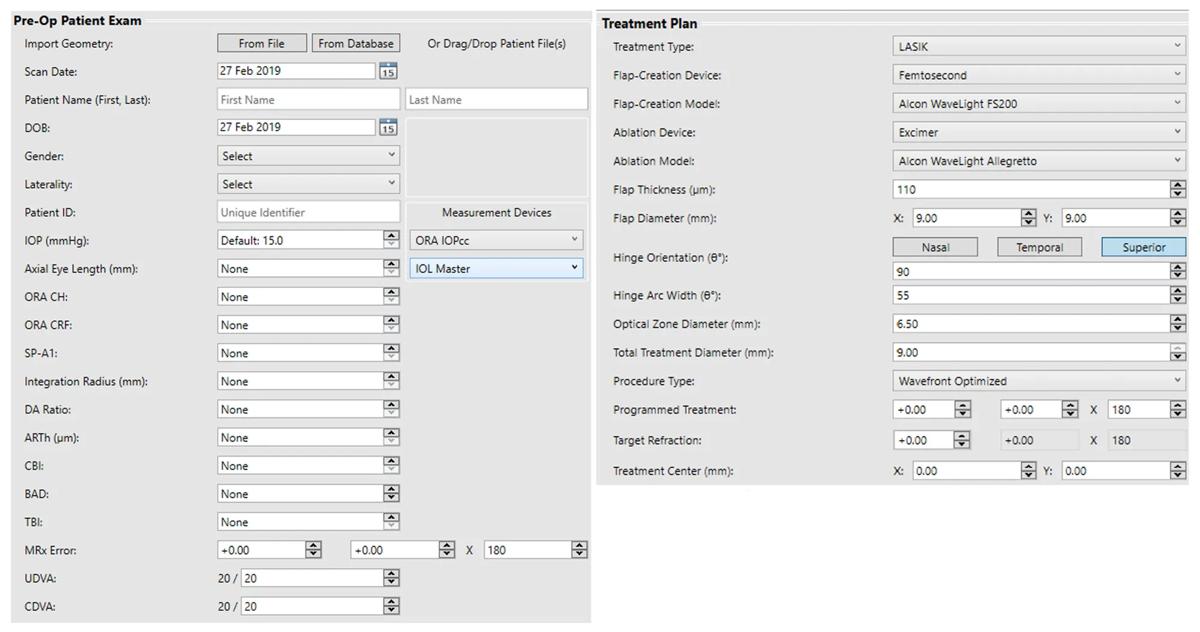
Image content: This image is available to view online.
View image online (https://assets.clevelandclinic.org/transform/c6290a3e-be6a-4ffc-82ae-2227a7aa7bad/keratoconus-data)
A computational approach to patient-specific prediction and risk assessment for ectasia.
When we input the target refraction, the model simulates the procedure, making a flap or removing tissue, for example. Then we can see the postintervention shape, stresses and strains and extract some clinically important variables.
The validation study of this model involved 20 actual cases of LASIK. While there was slight variance, the model got close to the actual outcomes of these patients. Accounting for preoperative corneal hysteresis (a simple global parameter of biomechanics) further improved LASIK prediction accuracy. We anticipate that predictions could be even more precise if we incorporate spatially resolved data from individual eyes.
In a study of corneal structural response after refractive surgery, we took a range of eyes — from healthy eyes to eyes with keratoconus — and ran models on them in their native state and then after PRK or LASIK. The idea was to estimate strain induced by a procedure. For example, one eye having LASIK -5.00 D was predicted to have a 15% increase in surgically induced strain. The same eye having KLEx was predicted to have a less than 12% increase in strain, due to preservation of anterior stromal fibers.
This study assumed that every eye, even the keratoconic eyes, had the same biomechanical properties.
We were varying only the geometry of the eye. If we can measure and incorporate patient-specific biomechanical data — from two- and three-dimensional optical coherence elastography, Brillouin spectroscopy or phase decorrelation OCT, for example — I think we can increase the fidelity of the simulations even more.
Advertisement
Corneal biomechanics is a key to early diagnosis of keratoconus. Biomechanics degrade (due to genetics, biochemical factors, eye rubbing and other factors) before clinical change is detectable. Tomography and epithelial mapping detect curvature changes later. As such, early biomechanical change may be a useful indication for corneal cross-linking and especially useful for laser vision correction screening.
Our next steps will be to merge clinical optical elasticity imaging with personalized 3D structural simulations as a tool for ectasia risk assessment, keratoconus progression risk prediction, laser vision correction optimization and customized keratoconus treatment planning.
Dr. Dupps is a laser vision correction surgeon at Cleveland Clinic Cole Eye Institute. This article was based on his booth presentation at the 2025 American Academy of Ophthalmology meeting.
Advertisement
Corneal imaging and interpretation play a major role

30% of references generated by ChatGPT don’t exist, according to one study

Motion-tracking Brillouin microscopy pinpoints corneal weakness in the anterior stroma
A look at emerging technology shaping retina surgery
A multitude of subspecialities offer versatility, variety
Study reveals more about the pathophysiology of Salzmann’s nodular degeneration
Therapies include steroid implants, immunomodulation and biologics
Studies continue to indicate effectiveness and safety
 Search