Locations:





Making use of autologous pericardium when options, and reconstruction references, are few
There are no easy solutions for acute infective tricuspid valve endocarditis in IV drug users, as the risk of prosthetic endocarditis in this population is high. Complete valve resection without replacement is feasible but leads to progressive right-sided heart failure. Reconstruction of the tricuspid valve with autologous pericardium is an alternative option, as demonstrated in the video case study below.
Advertisement
Cleveland Clinic is a non-profit academic medical center. Advertising on our site helps support our mission. We do not endorse non-Cleveland Clinic products or services. Policy
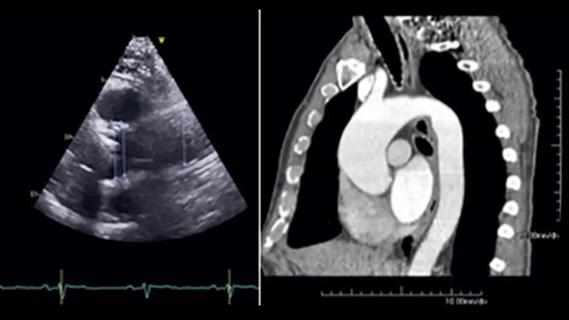
A 29-year-old female drug abuser with fever, hemoptysis and MRSA bacteremia was started on IV antibiotics. She looked frail and had prominent jugular venous pressure as well as 95 percent saturation on 2 liters of nasal cannula oxygen. She was not on inotropes and had a pulmonary artery pressure of 40/20 mmHg with a good cardiac index. Chest CT showed a large left pleural effusion with associated atelectasis of the left lung. The right lung had manifestations of septic emboli and a smaller pleural effusion.
A Cleveland Clinic surgical team led by cardiothoracic surgeon Faisal Bakaeen, MD, proceeded to excise the patient’s extensive infected and devitalized tissue around the tricuspid valve, leaving only a portion of the anterior leaflet to serve as a reference for reconstruction using autologous pericardium. Dr. Bakaeen walks us through the essential surgical steps — and their underlying rationale — in the narrated operative video below.
Video content: This video is available to watch online.
View video online (https://www.youtube.com/embed/9jbBhExzuU4?feature=oembed)
Advertisement
Advertisement

AHA statement details nuanced, evidence-based strategies
The benefits of multiarterial grafting are possible without opening the chest
Collaborative citywide initiative reshapes protocols to boost cardiac arrest survival
For severe cases, complete unroofing of the bridge is imperative
Lower threshold expanded revascularization candidacy without raising early complication rates

Elevated levels of the gut microbial metabolite predict prevalence and adverse outcomes in community-based study

They generally depend on the mutated gene, clone size and clinical setting
Large analysis adds to evidence that absolute diameter alone may miss vulnerable patients
 Search