Locations:





A practical look at patient selection, implant choice and the unanswered questions around long-term value
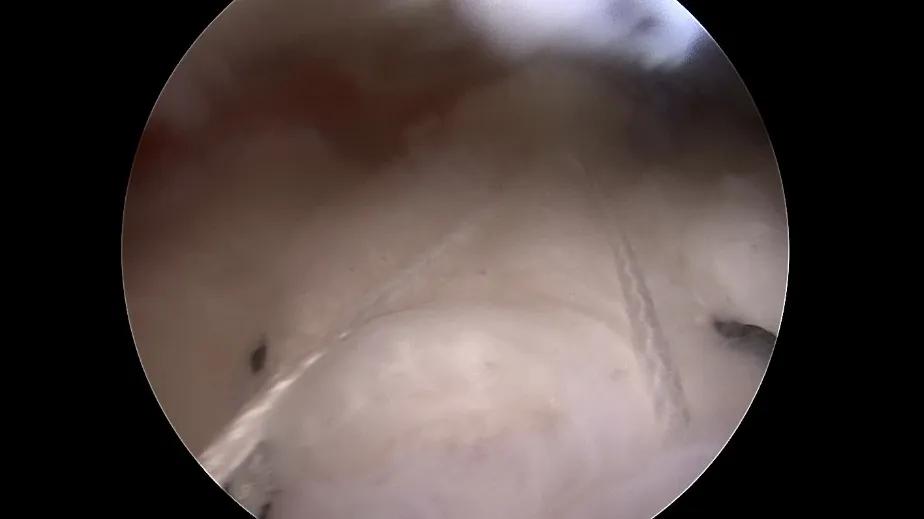
Image content: This image is available to view online.
View image online (https://assets.clevelandclinic.org/transform/50f28bb5-1fd6-4365-ab40-9ae0c93e7930/-rotator-cuff-repair-augmented)
Augmented rotator cuff repair
Pictured above: Arthroscopic visualization of a completed rotator cuff repair augmented with a bovine collagen implant.
Advertisement
Cleveland Clinic is a non-profit academic medical center. Advertising on our site helps support our mission. We do not endorse non-Cleveland Clinic products or services. Policy
In rotator cuff repair, the challenge is not only achieving fixation but maintaining biologic tendon healing over time.
Repair failure remains a concern particularly for patients with large or chronic tears and poor-quality tendon tissue. As a result, augmentation has emerged as a strategy to enhance tendon healing.
“Early efforts to reduce retear rates focused on structurally stronger repairs via innovations in implant choice and repair technique,” says Cleveland Clinic orthopaedic surgeon Joseph Tramer, MD. “More recently, the focus has shifted to improving the biologic environment that helps tendons heal.”
Dr. Tramer considers applying a graft or bioinductive implant when factors identified before or during surgery suggest the tendon is less likely to heal successfully after standard repair alone.
Factors that prompt him to consider augmentation include:
Advertisement
Many of these variables are incorporated into the Rotator Cuff Healing Index (RoHI), which can help quantify the risk of healing failure. Dr. Tramer uses the score during preoperative counseling, but the final decision to use augmentation is often made during surgery after assessing tendon quality, thickness, mobility and repair tension.
There are various types of grafts available for rotator cuff augmentation. Dr. Tramer most often uses two categories:
“We have access to a range of augmentation options and can tailor graft choice to tear pattern, tissue quality and patient-specific healing risk,” Dr. Tramer says.
At Cleveland Clinic, augmentation is used selectively rather than routinely.
Dr. Tramer first performs a standard arthroscopic repair with anchors and sutures. He then determines whether the repair would benefit from additional support based on the appearance and behavior of the tendon at the time of surgery.
Advertisement
“If I’m concerned that the tendon will need more support to heal back to bone, I utilize augmentation over the repaired tendon and secure it arthroscopically,” he says.
He emphasizes that augmentation is an adjunct to a repairable cuff tear, not a substitute for sound repair technique or a solution for every irreparable tear. However, having multiple graft options has expanded the range of patients who may be candidates for repair.
“Augmentation has increased my confidence in repairing some tears for which I previously may have recommended arthroplasty or other salvage options,” Dr. Tramer says. “It gives us another tool for patients with higher-risk tears or less favorable biology.”
Augmentation also may have a role in selected partial-thickness tears.
Historically, treatment options for symptomatic partial tears that failed conservative management were often limited to debridement or conversion to full-thickness takedown and repair. Bioinductive implants may offer an intermediate option by being placed over the diseased tendon to support healing without completing the tear.
“For selected symptomatic partial-thickness tears, this can provide a useful middle ground and may allow a faster recovery than takedown and repair,” Dr. Tramer says.
While augmentation is not necessary for every patient, having access to the full treatment spectrum — including standard repair, augmented repair, bioinductive treatment for partial tears and arthroplasty — can help surgeons better match treatment to pathology and healing risk.
Advertisement
Although augmentation adds cost, its use is increasing as evidence of improved healing grows. Whether that leads to better long-term outcomes, fewer revisions or greater value is uncertain.
“Some studies show lower retear rates with augmentation, but improved healing doesn’t always translate into better patient-reported outcomes in the short term,” Dr. Tramer says. “The key question is whether better healing leads to better long-term function, durability and value. Those answers will require longer follow-up.”
Advertisement
Advertisement
CT imaging using radiopaque markers can help assess healing after surgery
Ultrasound-guided debridement for selected patients with persistent symptoms
Cleveland Clinic’s new program uses a cross-institute model to provide complete care for women of all ages and athletic levels

PTs’ roles as educators and translators make them a natural fit for informatics

Innovative procedure offers less-invasive alternative to Latarjet procedure

Even patients with reported penicillin allergies can receive it without increased complications

Study challenges assumptions about risk evaluation in total hip revision
Protein expression in synovial fluid indicates patients’ immune factors may be involved
 Search