Locations:





Hani Najm, MD, on not squandering time, collaboration and more
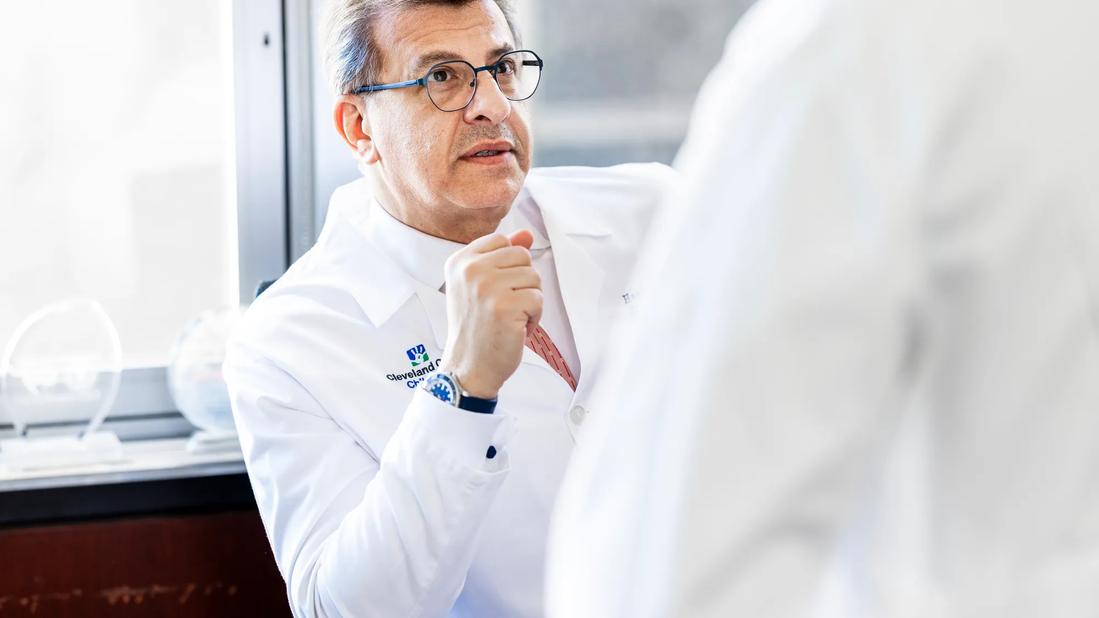
Image content: This image is available to view online.
View image online (https://assets.clevelandclinic.org/transform/a19f13b7-8cc9-44a5-947a-67961db3eb4e/CHP_5526166_01-27-25_035_LDJ)
650×450-Pediatrics-Najm
Hani Najm, MD, believes in not wasting a second. In surgery, and in life, his conviction is to not squander time or effort.For years, he not only put his energy into becoming an adult and pediatric cardiac surgeon but also into the Korean martial art of Taekwondo. He’s performed more than 5,000 operations and has achieved a surgical mortality rate approaching zero. And as a 5th Dan black belt, he won Saudi Arabia’s national Taekwondo championship three years in a row earlier in his youth.
Advertisement
Cleveland Clinic is a non-profit academic medical center. Advertising on our site helps support our mission. We do not endorse non-Cleveland Clinic products or services. Policy
“The only thing I did for years was medicine and Taekwondo. I was sparring people during training in the evening,” he jokes, “and then the next morning coming in a lab coat to the hospital taking care of people.”
While not as active in the martial art as he used to be, its lessons — about self-control, target achievement and the connections between mind, body and soul — influence him daily. “Soul being passion,” Dr. Najm adds. “People who don’t have passion in what they do will never excel. Mind is what we feed our brains with science and body is what we physically do to keep in shape. The three are the whole mark of success.”
You joined Cleveland Clinic last year. Why did you choose to practice here?
Working here exemplifies the pinnacle of any cardiac surgeon’s wish in their career. This opportunity came to me and I am very proud every time I walk through the operating room and see the words atop the door: “through these portals pass the world’s greatest cardiothoracic and vascular surgical teams.”
And now as Chair of Pediatric and Congenital Heart Surgery, I have the opportunity to put the congenital program on par with the adult program.
Cleveland Clinic often talks about the “Power of Every One,” which is the theme of its centennial campaign. What does this concept mean to you?
That collective thinking, collective intelligence and collective work can produce a synergistic effect. Therefore it is not a simple addition of efforts, it is multiplication of efforts. Hard work is infectious and becomes a culture in an enterprise when everybody is engaged in decision making. Everyone has a contribution to their area and this is where smart ideas come about. If we don’t tap into these resources it will be our loss for not using them.
Advertisement
Share a way that you decompress?
The first thing I do when I’m locked into negative thinking, I actively change my mood by telling myself what my life is blessed with from health to success. In seconds I start feeling better. At a certain time, everyone will be faced with bad things, but everyone has an abundance of good things in their life and it is that moment that we need to think about.
Anything else you would like to add?
Knowing what I know about heart surgery, what it takes to become one and what it takes to do it, if I had my life to live all over, I would do it again. There is nothing more gratifying than seeing a smile and hearing “thank you doctor for making my life better” from a parent or a patient. Having come from a different country, health system and different background altogether, I can say there is no perfect place in the world, but there are places that are better than others. People should feel very privileged that they are working here at Cleveland Clinic.
In general, we know that in the U.S. workforce, about 30 percent of an organization’s employees are engaged, 50 percent are neutral and 20 percent are disengaged. I would say be part of the engaged group. That’s what makes the place you work in better.
Advertisement
Advertisement
Key takeaways from the newest STS-Pedimacs report

Pediatric Syncope Clinic helps rule out serious disease and guide next steps
Cleveland Clinic findings highlight gains in stability, chest wall contouring and correction

What the discovery means for clinicians and patients
Why preparedness matters right now

Early diagnosis, specialized assessment and high-frequency motor-based therapy can improve outcomes

Transplant centers vary substantially in how they assess, document and follow patients after allogeneic transplantation

Helping pediatricians and families make safer, more individualized activity decisions
 Search