Locations:





Expanded bevy of dedicated ORs will feature customized designs, leading-edge technology, optimized workflows
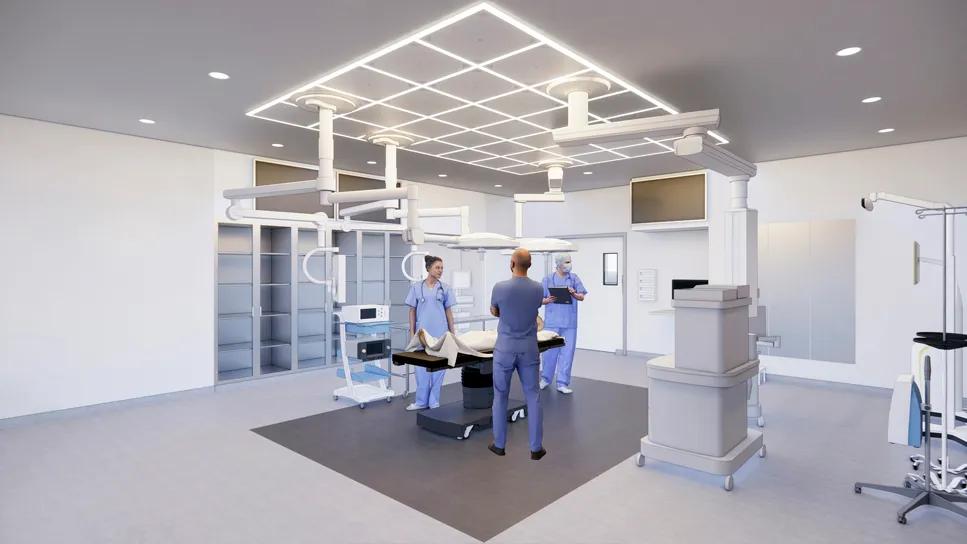
Image content: This image is available to view online.
View image online (https://assets.clevelandclinic.org/transform/ef5f43ff-3184-49c5-bd38-4e716112b1f3/neurosurgical-operating-room-rendering)
three health professionals standing in a futuristic operating room
When Cleveland Clinic’s new 1-million-square-foot Neurological Institute building opens on its Main Campus in the early weeks of 2027, it will usher in an era of expanded neurosurgical capabilities for the health system.
Advertisement
Cleveland Clinic is a non-profit academic medical center. Advertising on our site helps support our mission. We do not endorse non-Cleveland Clinic products or services. Policy
Consult QD caught up with two Cleveland Clinic clinicians who contributed to the planning and design of the new building’s surgical suites — spine surgeon Dominic Pelle, MD, Director of the Center for Spine and Pain Medicine, and neurosurgery nurse manager Nicholas Shannon, BSN, RN, CNOR — to learn more. Below are eight specific neurosurgical enhancements they anticipate with the new facility and how these changes will matter to patients and caregivers alike.
The most fundamental change is one of scale. The new building will open with 14 operating rooms (ORs) dedicated solely to neurosurgery — brain, spine or peripheral nerve surgery — with capacity to ultimately expand to 18 ORs. That’s a sizeable increase over the current state, in which neurosurgical teams run cases in 10 to 12 ORs per day, all of which are shared with other surgical disciplines in multiple locations on Cleveland Clinic’s Main Campus.
“The ability to operate that many ORs dedicated exclusively to neurosurgery and spine surgery will significantly expand our capacity to care for patients in need,” says Dr. Pelle. “Just as importantly, these ORs will bring specialized instrumentation, advanced technology and highly experienced nurses and surgical teams together in one centralized environment, all focused on the care of neurosurgical and spine patients. This level of integration creates opportunities for greater efficiency, collaboration and innovation while giving us the flexibility to incorporate new technologies and approaches as the field evolves. Few major centers have had the opportunity to design and centralize their neurosurgical services at this scale, with an environment built not only for the care we provide today but also for the care we will provide in the future.”
Advertisement
“Having these additional ORs specific to neurosurgery and spine surgery will allow patients to be scheduled faster,” adds Shannon. “And because the rooms are dedicated to our specialty, we expect to realize efficiencies from always knowing where our supplies are since we won’t be sharing space with other disciplines. Our cases will flow more smoothly, which especially matters for urgent and emergent surgeries where every minute counts.”
Although some of the ORs will be given priority for certain types of neurosurgery (detailed below), all are designed to be fully interchangeable between brain, spine and nerve surgery cases, accommodating various equipment and patient positioning orientations to support operative needs.
Additionally, for all the ORs, careful tailoring went into countless aspects of room design. Examples include:
Advertisement
The building’s surgical floor is designed to make patient flow as efficient as possible. Six induction rooms are located throughout, enabling anesthesia preparation outside the OR. This is expected to reduce surgeon wait times and maximize the use of ORs for actual surgery.
Additionally, preoperative and postoperative spaces have been placed in spots central to the location of ORs throughout the floor. Thirty-six patient bays are equipped to manage patients’ preoperative care as well as Phase I and Phase II postoperative recovery. “This design for dual use of these spaces will promote enhanced continuity of care,” Shannon notes.
“The overall design is set up for efficiency and safety from preoperative care to surgery to postoperative care,” Dr. Pelle says, “and features like the induction rooms provide spaces for discussion with the anesthesiologist and other team members to ensure none of a patient’s nuanced needs are missed.”
Soon after opening, two of the ORs will feature a ceiling-mounted MRI magnet (IMRIS InVision Surgical Theatre) that can be moved between the two adjacent surgical spaces, enabling advanced intraoperative imaging in each room. This is a notable advance from Cleveland Clinic’s current single MRI-equipped neurosurgical suite, which is not closely integrated with the primary ORs used for neurosurgery.
The movable system serving two ORs will allow for use of real-time intraoperative MRI in more cases, primarily in the setting of brain tumor or epilepsy surgeries. These two IMRIS suites also will feature the NeuroBlate System, a minimally invasive, robotically controlled laser ablation tool, as well as Brainlab image-guided surgical navigation technology.
Advertisement
Two other ORs have been designed as “cranial ORs” to serve as priority locations for skull base neurosurgery, for treatment of skull base tumors, trigeminal neuralgia, structural defects and the like. While these rooms, like the others, can be used for any type of neurosurgery, they are specially equipped to be the go-to locations for these cases.
“These rooms will have in-field monitors and integrated video systems tailored to endoscopic skull base procedures, along with specialized foot pedals that control drills and aspirators specific for these types of operations,” Shannon explains. “These features will make it far more efficient for the OR nurses to set up and manage these rooms and for the skull base surgeons to toggle between devices and complete their complex operations.”
As detailed in a previous Consult QD post, one of the surgical suites will be a hybrid OR that combines the surgical functionality of a traditional OR with the high-resolution diagnostic imaging of an angiography suite. It does so with a fixed imaging system that’s mounted to a robot arm and provides real-time diagnostic-quality angiography and CT capabilities within the surgical field.
This space will be ideal for patients requiring both endovascular and open surgical interventions, as it eliminates the risks and delays of transport between different procedural settings. It offers particular utility in cerebrovascular surgery and other operations that demand high-quality intraprocedural imaging of the vasculature. “In spine surgery, it will be helpful in cases involving highly vascularized tumors or tumors that encase the vertebral artery and require stenting to enable safe resection,” Dr. Pelle notes.
Advertisement
The new building will allow for acquisition of additional robotic surgery systems beyond the one currently used for neurosurgery, primarily spine procedures. This increased robotic surgical capacity is prompting adoption of next-generation imaging guidance systems for robotic spine surgery, which will integrate preoperative MRI or CT imaging with software for procedural planning and intraoperative navigation.
“The new software will allow us to do highly accurate advance planning of, for example, screw placements, osteotomies and alignment corrections, ultimately enabling greater surgical precision and efficiency than is possible with current systems,” Dr. Pelle says.
An overarching effect anticipated by both Shannon and Dr. Pelle is the impact on the culture and morale across all disciplines of Cleveland Clinic’s broad neurosurgical team.
“Having all these new spaces dedicated solely to neurosurgery, with seamlessly integrated customized equipment and improved workflows, is exciting to our caregivers and will likely strengthen everyone’s pride in our shared mission,” Shannon says.
“The members of our neurosurgical teams bring extraordinary levels of expertise, energy and innovation to the care of our patients,” adds Dr. Pelle. “Soon we’ll have an operative environment designed to match that expertise — not only with the advanced technology and capabilities we need today, but with the flexibility to incorporate the technologies, techniques and surgical platforms that will define the care of the future. We’re building a space that can evolve alongside our field and allow our teams to continue pushing what is possible in neurosurgical care. It’s an incredibly exciting time.”
Advertisement

Routine capture of standardized neuroperformance data may expand and refine investigations

Reimagining the outpatient neurological visit with routine capture of neuroperformance data

Advanced surgical suite in our soon-to-open facility promises to redefine care standards

Phase 3 STELLAR trial underscores role of molecular stratification in glioma care

A passionate specialist surveys the field’s past, present and future

Today’s research helps illuminate tomorrow’s needs
Novel ‘assessment center’ will be a partner in care by serving as an engine of structured data collection

What it’s like working in neurology critical care and what to consider before entering the specialty
 Search