Locations:





Housing multidisciplinary clinicians in one leading-edge facility can transform GME along with patient care
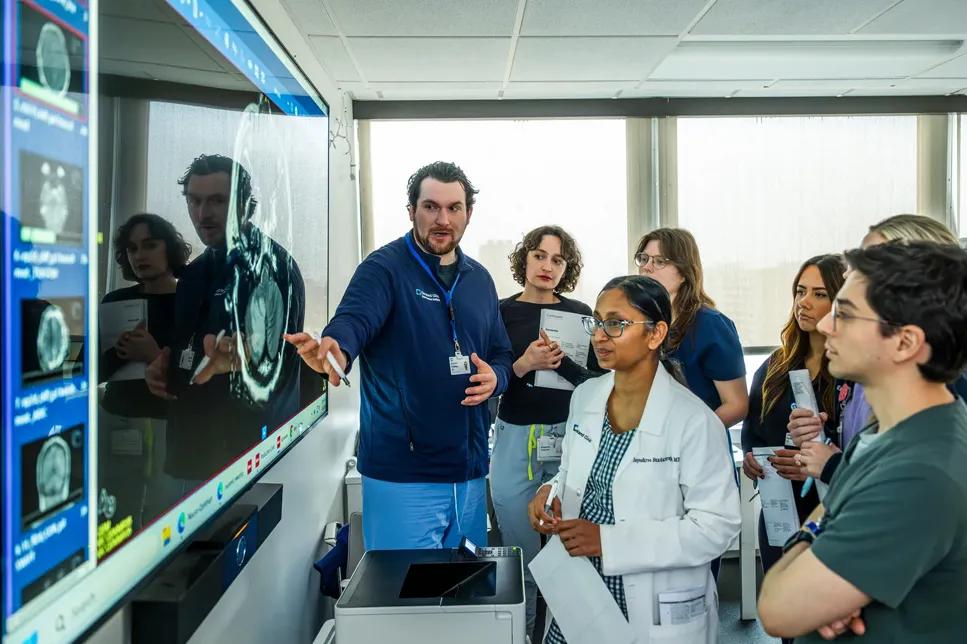
Image content: This image is available to view online.
View image online (https://assets.clevelandclinic.org/transform/3c348bf2-5103-4aa4-819f-5fa5197c9847/neuro-post-graduate-students-with-teacher)
medical students gathered around a large monitor showing a brain image
Patient care and research are not the only components of Cleveland Clinic’s mission to be substantially advanced when the health system opens its new 1-million-square-foot Neurological Institute building in early 2027. The technologically advanced facility — which will bring neurological providers and services under one roof to diagnose, treat and research conditions of the brain, spine and nervous system — has also been designed to serve as a neuro-focused mecca for enhanced graduate medical education.
Advertisement
Cleveland Clinic is a non-profit academic medical center. Advertising on our site helps support our mission. We do not endorse non-Cleveland Clinic products or services. Policy
The Neurological Institute trains more than 200 residents and fellows and provides core curriculum training to more than 150 medical students; institute leaders and staff view the training of these future providers as paramount to transforming neurological care.
“Education is how we make innovation sustainable,” says MaryAnn Mays, MD, Vice Chair of Education for the Neurological Institute, Associate Program Director for the Neurology Residency and a neurologist specializing in headache medicine. “Research produces discoveries and innovation builds new tools, but education ensures that those advancements reach patients for generations to come.”
The new building’s blend of design, functionality and technology will reshape medical education for trainees in the Neurological Institute’s 30-plus training programs, which include core residencies in neurology, neurosurgery, child neurology, psychiatry, and physical medicine and rehabilitation.
Four key facets of the building’s conception and design, detailed below, aim to enhance neurologically oriented training and make it more interdisciplinary across the board.
“This will be the largest gathering of inpatient and outpatient neurological care in one building in the United States,” says Dr. Mays. Neurological subspecialists will share space and work hand in hand with pharmacists, radiologists and other providers. Dedicated trainee workspaces and conference rooms have been designed to cultivate collaboration among residents and fellows across all five core training programs.
Advertisement
“We intend to foster discussion among trainees about interesting patients they can learn from and research opportunities they can pursue together,” Dr. Mays explains. “They will gain exposure to the full spectrum of neurological care — from ambulatory clinics to acute inpatient services — while working alongside colleagues in related disciplines such as rehabilitation, all in one building.”
To facilitate collaboration, the Neurological Institute launched NI Nuggets, a monthly interdisciplinary training series where providers share expertise on a range of conditions. For instance, Dr. Mays recently presented on trigeminal neuralgia. She was joined by a pharmacist who discussed pertinent medications, a nurse who performs triage in surgery and a physician assistant who cares for postoperative patients.
“We are demonstrating how caregivers’ roles are interrelated,” says Dr. Mays, “and we are training providers the same way we will treat patients — collaboratively.”
Patient encounters are a central building block of residency programs. “Residents will continue to meet and talk with patients,” Dr. Mays notes. “The difference will be automated data gathering that takes place in the new building’s neurological assessment center,” a centralized space on the ground floor. Characterization of neurological function will take place largely in this center (detailed in a prior Consult QD article) where outpatients will check in digitally and then complete a series of neuroperformance modules to assess their gait, balance, voice and other functions. The modules will be completed as patients walk from the building entrance to their physician visit.
Advertisement
“Traditionally, a resident would gather this data, but it provides only one snapshot in time,” Dr. Mays explains. “This new method will capture objective data that can be regularly measured at each of a patient’s appointments over years, providing a complete and consistent longitudinal picture. This also will free up residents to spend more time with patients doing high-order clinical reasoning and managing their care.”
Digital assessments via the neurological assessment center are just one example of innovations in the new building. The Neurological Institute is building upon its expertise in teleneurology and the new facility’s advanced connectivity to provide distance-enabled direct care to patients at facilities across the nation and the world, including those at the Lou Ruvo Center for Brain Health in Las Vegas and Cleveland Clinic hospitals in Florida, London and Abu Dhabi.
Neurosurgery residents will be exposed to state-of-the-art technologies in the 14 operating rooms the building will house at its opening. One of those rooms is a hybrid OR featuring a fixed imaging system mounted to a robot arm that provides diagnostic-quality angiography and CT capabilities within the surgical field. It also includes a surgical bed capable of custom positioning for complex approaches that’s integrated with stereotactic equipment and image guidance systems.
Additionally, six imaging rooms with MRI machines (including one 7T machine) are located near patient rooms, allowing for more efficient care and improved workflows.
Advertisement
Many rooms in the building feature modular layouts so they can be adapted for different purposes. For example, meeting rooms can be enlarged or divided into smaller areas.
“The space is flexible whether you want a close collaboration between a provider and trainees or seating for more than 100 residents and fellows,” says Dr. Mays. “It is a thoughtful and efficient use of space.”
Operating rooms are located close to ICUs so trainees can easily move between the two to see patients, and dual-purpose exam rooms are embedded with office nooks for physicians or trainees. The building also includes integrated research facilities so clinicians, scientists and engineers can work together to align medical care and research. Trainees will further benefit from access to data from the Cleveland Clinic Brain Study, a 20-year longitudinal investigation examining changes in the brain and body in the years before a neurological disease is diagnosed.
The building’s design also prioritizes caregiver well-being, a vital consideration for graduate medical education trainees who work long hours. The facility features open space and natural light, as well as a decompression room near the ICU where providers can step aside and unwind if they’ve had a difficult day or experienced a bad patient outcome.
While the new building on Cleveland Clinic’s Main Campus is a landmark location, resources and knowledge will be shared at regional hubs throughout the surrounding community and counties. “As we hire more faculty with expertise and interest in teaching, we are giving them opportunities to train residents in the community to expose them to a broader patient spectrum and give trainees exposure to a wider range of physician approaches,” says Dr. Mays.
Advertisement
With the opening of the new building, Cleveland Clinic anticipates hiring an additional 650 caregivers. The Neurological Institute will expand graduate medical education programs as well. In 2027, it will roll out an advanced practice provider fellowship, enrolling two fellows per year who will participate in clinical rounds in general neurology, neurosurgery, stroke care and an elective, including cognitive neurology, headache and sleep medicine.
“Having a world-class building like this is going to attract world-class talent that will change the lives of patients across the country,” Dr. Mays concludes.
Advertisement
Maintaining connections leads to referrals, recruitment and more
A commitment to sharing expertise has fostered a global exchange of ideas

As the U.S. has seen an increase in respiratory-related morbidity and mortality, supporting future respiratory researchers has become imperative

Continuous Improvement model makes success repeatable
A century-old medical tradition inspired the weekly complex-case reviews in Rheumatology
Medical students will complete five weeks of clinical training
Findings about the tool's utility were presented at the American Society of Nephology’s 2022 Annual Meeting
Survey and focus group findings highlight key concerns among PHM leaders
 Search