Locations:





Building designed to support more comprehensive care for complex patients
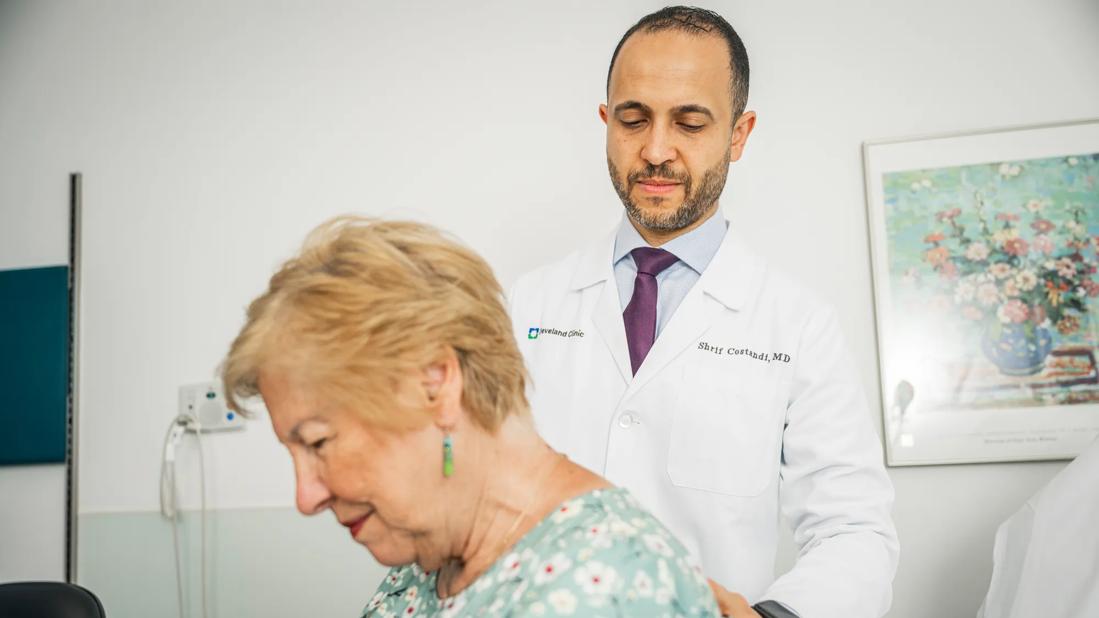
Image content: This image is available to view online.
View image online (https://assets.clevelandclinic.org/transform/0ccc1255-f7e4-4b3b-baf3-4920fc8f7b73/NEU_8285508_05-18-26_035_SCG)
Dr. Costandi examining back of female patient
When Cleveland Clinic’s new 1 million-square-foot Neurological Building opens in 2027, patients seeking care for chronic pain management will be treated in a space designed to strengthen connections among specialties and services. Pain management physicians will practice in close proximity to research, imaging and other clinical colleagues who share the goal of improving the lives of patients with neurological conditions.
Advertisement
Cleveland Clinic is a non-profit academic medical center. Advertising on our site helps support our mission. We do not endorse non-Cleveland Clinic products or services. Policy
“Pain management is most successful when we take a multidisciplinary approach, and the new building enhances our ability to do that. We’ll put all our minds together and increase collaboration,” says pain management specialist Sherif Costandi, MD. “And increased collaboration leads to more options and better outcomes for our patients.”
Currently, the health system’s Pain Management Department is located in the W.O. Walker Building. It is on Main Campus but separated from most of Neurology and other medical disciplines often involved in caring for patients with chronic pain.
The new building not only will bring together multiple aspects of neurologic care, but also will connect by skyway to Building J, the campus’s central hub. Inpatient and outpatient services will be consolidated for patients with conditions affecting the brain, spine and nerves. It is expected to be the world’s largest neuroscience facility, with leading-edge technology designed to support data-driven decision-making.
When it opens, Cleveland Clinic’s Neurological Building will include 210 inpatient rooms, with capacity for expansion. It also will house imaging, infusion, surgical services and neuroscience research labs.
Pain Management offices, exam rooms and six procedure rooms, including two flexible OR spaces, will be located on the fifth floor of the building’s 15 stories. The space will be equipped with new tablets, monitors, C-arms and other tools.
“We’ll be located next to the spine surgeons and our physical medicine and rehabilitation colleagues,” says Dr. Costandi. “Patients will be able to come to the office for assessment and have their procedure on the same floor. It’s very convenient.”
Advertisement
Facilities that physically connect services may be especially important for patients with pain, whose conditions are often intertwined with other diseases and whose symptoms can affect many aspects of daily life.
“Chronic pain affects not just the nerves or organs, but also a person’s mood, quality of life and sleep,” says Dr. Costandi. “It can be hard to function well if you’re in pain, so the muscles can become deconditioned because you’re not using them. Pain affects sleep quality, and if you’re not sleeping well, that’s going to affect your healing and recovery, which in turn can affect pain levels the next day. So our patients often end up battling pain while trapped in multiple vicious cycles.”
“What’s really important in the new building, then, is that patients will have access to multiple specialists: sleep specialists, physical therapists, spine surgeons if surgical intervention is needed, and PM&R for musculoskeletal problems," he adds. "If a patient has diabetic neuropathy, our neurologists also will be in the building. So it’s really about bringing everything together for our pain patients.”
Ambulatory patients who come to the facility for pain management and other conditions also will visit a waiting area equipped with tools for assessing gait, cognitive and visuospatial processing, dexterity and voice patterns. Collected data will be transferred to the patient’s electronic medical record and made immediately available to the clinician during the appointment.
The new environment also will provide more space for research, allowing expansion of pain management clinical trials and related studies. The department already has well-established research programs in a variety of neuromodulation technologies.
Advertisement
“There will be a lot of research trials for different modalities of neuromodulation,” says Dr. Costandi. “We’re constantly working with different waveforms, and we have newer technology, including closed-loop neuromodulation. The new building will provide more space and the flexibility to accommodate new technology and the human resources required to grow these trials. Our vision is to expand our offerings for treating patients’ pain conditions.”
Other future directions include further exploration of biologics for regenerating spinal discs and tissue involved in other pain-related conditions. “Again, we’re hoping to expand the use of regenerative medicine in the management of chronic pain,” says Dr. Costandi.
For clinicians and trainees, Dr. Costandi expects the multispecialty environment to reinforce the importance of working together as a unit.
“As medicine advances, more specialties emerge, but as more specialties emerge, we can become less aware of what others can do. We’re going to model an approach in which different disciplines integrate to work together toward a diagnosis,” he says. “Having everyone together in one space improves organic communication and reduces the likelihood of fragmented patient care.”
Advertisement
Advertisement

What the postoperative data show so far

Add AI to the list of tools expected to advance care for pain patients
Radiofrequency ablation significantly reduces symptom severity, shrinks nodules

Telehealth aids in treatment of fibromyalgia and median arcuate ligament syndrome
Program enhances cooperation between traditional and non-pharmacologic care
A surgeon’s perspective: three patient groups

Compassion, communication and critical thinking are key

Researchers seek solutions to siloed care, missed diagnoses and limited access to trauma-informed therapies
 Search