Locations:





Minimally invasive surgery is the preferred approach in many cases, but not all
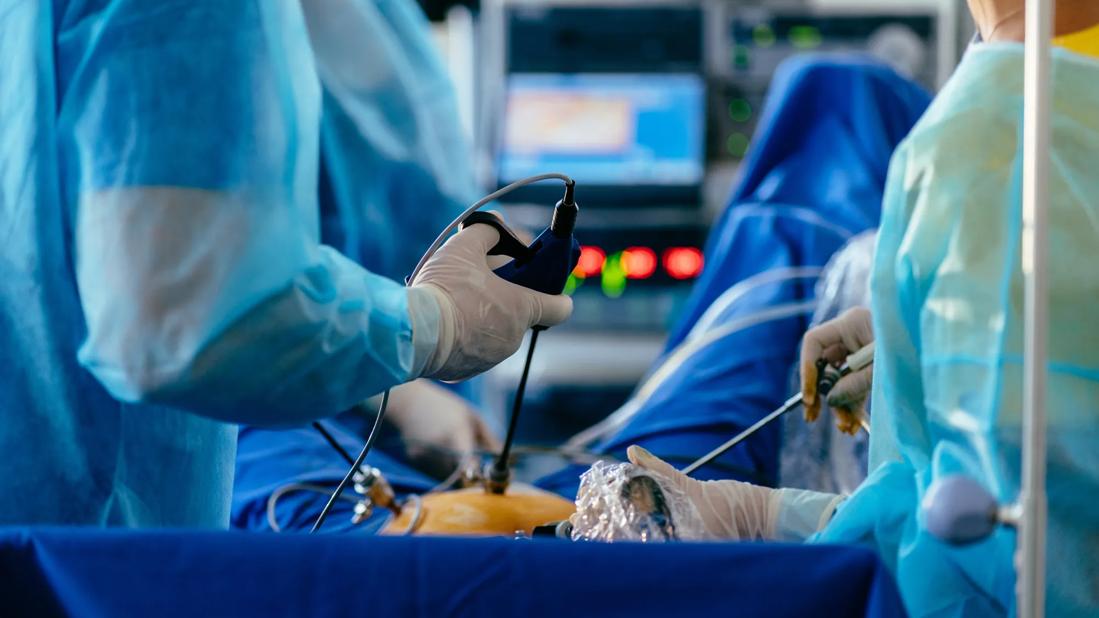
Image content: This image is available to view online.
View image online (https://assets.clevelandclinic.org/transform/f15d261b-255c-4583-8975-c196f60bfab7/laparoscopic-gynecology-surgery-2256470061)
surgeons performing laparoscopic surgery
Minimally invasive gynecologic surgery (MIGS) is widely established as the preferred approach for many benign gynecologic procedures when feasible. Still, variables related to the patient’s pathology and preferences, as well as surgeon experience and judgment, mean that individual cases can present more complex decision-making.
Advertisement
Cleveland Clinic is a non-profit academic medical center. Advertising on our site helps support our mission. We do not endorse non-Cleveland Clinic products or services. Policy
In an interview with Consult QD, Paulette Griffin, DO, a specialist in minimally invasive gynecologic surgery at Cleveland Clinic in Florida, discussed factors that influence those decisions, including patient anatomy, involvement of other specialists and the role of patient preference.
“From a gynecologic standpoint, most of our surgeries are done with minimally invasive techniques,” says Dr. Griffin. “There are significant patient benefits, particularly in recovery.”
Benefits include:
What are the most common MIGS procedures you're performing?
I am a complex benign gynecologist, so I will perform surgery for fibroids, endometriosis excisions and hysterectomy. Additional procedures that I perform include surgeries for benign ovarian cysts, cesarean scar defect repairs and fertility optimizing procedures.
Depending on the clinical scenario, there might be a need to still do some of these procedures with an open approach. If there are concerns of malignancy, then a referral to a GYN oncologist is warranted and there may be a need for larger incisions.
Is that to preserve specimen integrity? What are the upsides in that situation?
If there is a concern for malignancy, it's often necessary for a GYN oncologist to take the mass or specimen out in its entirety without disruption. The specimen would have to be disrupted to be removed through very small incisions.
Advertisement
Now, there are still times when the patient's anatomy or the size of the pathology makes a minimally invasive approach less feasible, although it must be massive for us to choose an open approach. But if we do, it's because we would want to minimize the patient's time in the operating room and/or have access to the full anatomy.
So, there are still occasions we will recommend an open technique, and it's going to be provider and patient dependent.
Can you give an example of anatomical issues that might inform a decision to use laparotomy?
An extensively large pelvic mass or an extensively large uterus that extends to the upper abdomen might call for a larger incision, although there are times we can still remove this with a minimally invasive approach.
Is it obvious to you early on which approach will be right? And in cases where it may not be that obvious, what are some of the things that you do to help clarify it for yourself?
Physical exam and imaging are helpful tools to determine the best approach. If the approach is still unclear, then MRI is useful.
Does the patient ever weigh in or have a preference?
Absolutely. Surgery is always a patient’s choice. It is important to honor patient autonomy on whether they want to proceed with surgery, and then the route for surgery. Very rarely would a patient prefer an open technique, but if that is their preference, we would try to discuss the risks and benefits of both techniques.If, as a provider, I suggest an open technique, then I would let the patient know that this would be my recommendation and why I feel that it would be safest for the patient.
Advertisement
If a provider recommends an open technique for the patient, but the patient still feels that they desire a minimally invasive technique, the patient might be advised to seek a second opinion.
However, we always take the patient's best interest to heart when we choose which route we're taking in surgery, and the decision is always one shared between patient and provider.
Are some providers still more comfortable choosing open surgery?
Some surgeons are going to be more comfortable with open techniques for some larger pathologies. However, providers who have had fellowship training, or others who have had training specifically in minimally invasive gynecology, might be more likely to pursue a minimally invasive approach than perhaps a general benign gynecologist.
Are you doing robotically assisted surgery as well?
Yes. Minimally invasive surgeries for gynecology can involve traditional laparoscopic surgeries, or they can involve robotic assistance. Both use small incisions and offer the same advantages as far as minimally invasive approaches.
Another technique, vNOTES – vaginal natural orifice transluminal endoscopic surgery – can be used to perform hysterectomies or adnexal procedures through the vagina. vNOTES can be done laparoscopically and, in some cases, robotically. This has many of the same advantages as other minimally invasive techniques. An additional advantage is that there is no abdominal incision.
Is that a newer technique?
It is, and whether providers can offer it depends on their training and experience.
Advertisement
For OB/GYN generalists or primary care physicians, what else is worth pointing out?
I think it’s important to underscore that minimally invasive approaches can improve visualization of the pathology and dissection precision. Some providers may feel that certain scar-tissue formations make an open technique preferable, but that's not necessarily so. In many cases, you can still visualize your anatomy much better laparoscopically than through an open technique.
It’s also important to remember the value of reaching out to a more experienced surgeon when needed. I would welcome my partners to call me for help in guiding best surgical approaches or management for a patient.
Is there anything you're excited about in terms of the future of minimally invasive gynecologic surgery?
Newer robotic systems offer a lot of advantages for the surgeon, and emerging AI-enabled tools may soon allow for real-time video consults in cases where additional input is needed.
VNOTES can lead to great outcomes for select patients. They can really have reduced postoperative pain and improved recovery. That's a technique that I'm excited about and that I expect to see more gynecologic surgeons adopting as time goes on.
Advertisement
Advertisement

Low-dose aspirin, more frequent checkups may lower risks
History of laparoscopy with morcellation should inform differential

Akron General project highlights the benefits of doula partnerships

Change eliminates waste associated with dual-field approach
Researchers compare two image modes in detecting left ventricular remodeling

Nutrition and cooking program supports maternal-infant health
New moniker brings clarity to this complex condition

A device implanted at the ankle joins the lineup of third-line treatments
 Search