Locations:





Collaborative citywide initiative reshapes protocols to boost cardiac arrest survival
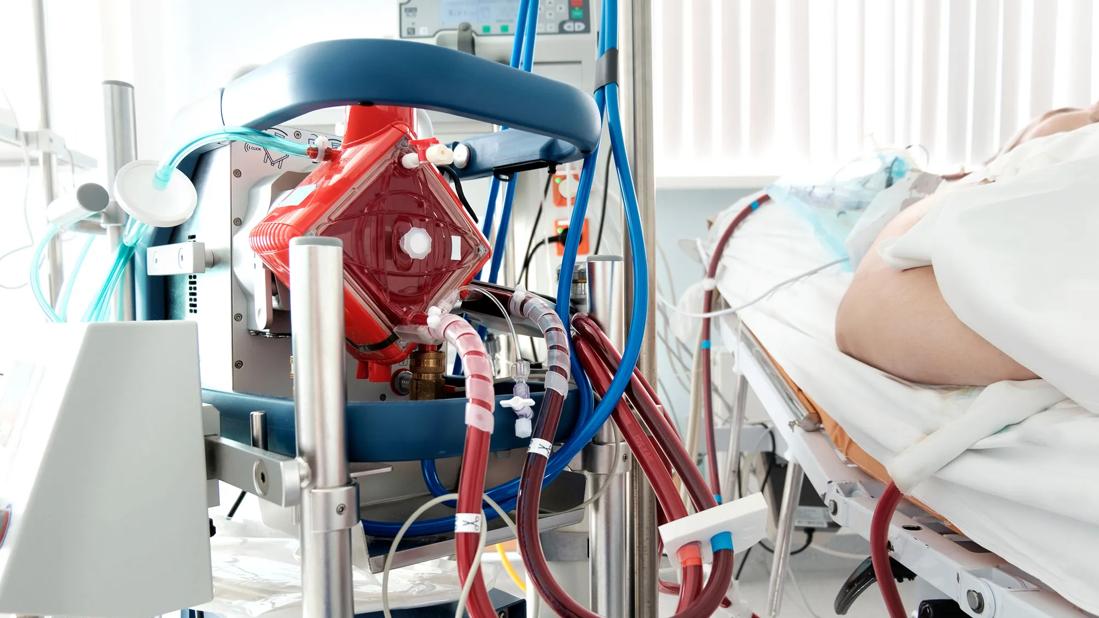
Image content: This image is available to view online.
View image online (https://assets.clevelandclinic.org/transform/0d906a24-13ae-4a13-ba93-5cebfba2ec38/ecmo-used-icu-998260308)
ECMO machine hooked up to a hospital patient
Approximately 370,000 cases of out-of-hospital cardiac arrest (OHCA) occur each year in the United States. Despite advances in emergency medical services (EMS) and advanced cardiovascular life support, fewer than 10% of patients who suffer OHCA survive to hospital discharge.
Advertisement
Cleveland Clinic is a non-profit academic medical center. Advertising on our site helps support our mission. We do not endorse non-Cleveland Clinic products or services. Policy
For patients with initial shockable rhythms — ventricular fibrillation (VF) or pulseless ventricular tachycardia (VT) — the survival rate is approximately 30%. But when VF or VT proves refractory to standard resuscitation by requiring more than three shocks or 10 minutes of cardiopulmonary resuscitation, survival plummets to roughly 5%. In this setting, extracorporeal cardiopulmonary resuscitation (ECPR) — rapid initiation of venoarterial extracorporeal membrane oxygenation (VA-ECMO) during active cardiac arrest — can serve as a critical bridge.
By mechanically restoring systemic circulation and blood oxygenation, ECPR maintains end-organ perfusion to allow a clinical team to diagnose and reverse the underlying cause of arrest, such as an acute coronary occlusion.
While ECPR’s utility is well established for in-hospital cardiac arrest, expanding its use to arrests occurring outside the hospital is logistically daunting. Cleveland Clinic recently developed its own ECPR program for OHCA, which is part of a larger regional system-of-care initiative spearheaded by Cleveland Clinic to deliver rapid mechanical circulatory support for people suffering OHCA within the city of Cleveland, Ohio.
The new prehospital ECPR initiative builds directly on the foundation of Cleveland Clinic’s cardiogenic shock team, created in 2018 to formalize multidisciplinary management of patients requiring temporary mechanical circulatory support. The shock team initially structured rapid-response triage for inpatients and critical care transport transfers from regional hospitals. The team subsequently expanded its scope to provide ECPR to eligible inpatients with refractory cardiac arrest.
Advertisement
“We recognized an opportunity to take it one step further by extending this care to community settings,” says Edward Soltesz, MD, MPH, a cardiothoracic surgeon deeply involved in the shock team and ECPR initiatives. “We saw that the ability to create some structure and process when first responders come upon someone in cardiac arrest could improve survival by enabling institution of ECMO in less than an hour after OHCA — and ideally considerably sooner.”
While peripheral VA-ECMO cannulation is a familiar procedure for experienced surgical and interventional teams, organizing a hyperacute response for unknown arrivals from the field poses massive administrative challenges.
“Cannulation for ECMO is very straightforward,” Dr. Soltesz says. “But when you’re treating an OHCA patient, all the steps that lead up to making that cannulation possible represent an operations nightmare. How do you strategize to develop the first communication stream between providers in the field and those in the hospital? How do you coordinate between the cardiovascular team and the emergency department [ED] team? How do you deploy a whole host of caregivers at a moment’s notice? And it’s not a static team but what I call ‘teaming’ — preparing a range of different people to understand the strategy and the process so they can come together whenever needed. It’s tremendously complex.”
Cleveland Clinic’s efforts to unravel those complexities were led by interventional cardiologist Jacqueline Tamis-Holland, MD. She and colleagues started by drawing on the published literature supporting ECPR for OHCA (recapped here) and the experiences of early adopters of ECPR in Paris, Minnesota and Prague. A key takeaway from those experiences, she says, is that an institution must establish the requisite foundational infrastructure before attempting prehospital activation.
Advertisement
“Success depends on starting ECPR within 10 to 15 minutes of a patient’s arrival,” Dr. Tamis-Holland notes. “That means having a cath lab available 24/7 that can immediately take these patients and having an ECMO-capable operator available at all times. It means having fluoroscopy to confirm ECMO placement (or, alternatively, immediately available transesophageal echo). It also means having deep expertise in postprocedural critical care. Once you have all that infrastructure in place, it becomes a logistical operation.”
To streamline rapid activation, Cleveland Clinic modified its centralized ECMO paging process. Paging operator scripts were refined to eliminate lengthy verbal intake checks, ensuring that field notifications immediately page out the designated multidisciplinary team.
The program established a “cannulator of the day” role to be rotated among primary specialists charged with leading the call and performing cannulation if a case presents. A team of approximately 12 designated cannulators undergo regular simulation training sessions to keep their cannulation skills fresh and efficient under simulated cardiac arrest conditions.
Establishing clear eligibility criteria is vital to ensuring that ECPR is deployed for patients with a meaningful chance of favorable recovery while avoiding nonviable cannulations. “In the hospital, providers already know the patient’s history,” Dr. Tamis-Holland explains. “For out-of-hospital cases, you need to be selective because you don’t know the history. But it’s a balancing act. If the criteria are too selective, you’ll never get any cases; if they’re too broad, you get people with very low survival chances due to extensive comorbidities.”
Advertisement
She notes that the core criteria are age 18 to 70 years, having had a witnessed arrest, having an initial rhythm of VF or pulseless VT, having received mechanical CPR and having an estimated transport time under 30 minutes. Full eligibility criteria are detailed in the figure below. The figure also summarizes the initial workflow of Cleveland Clinic’s ECPR, although Dr. Tamis-Holland notes this workflow is undergoing continual refinement.
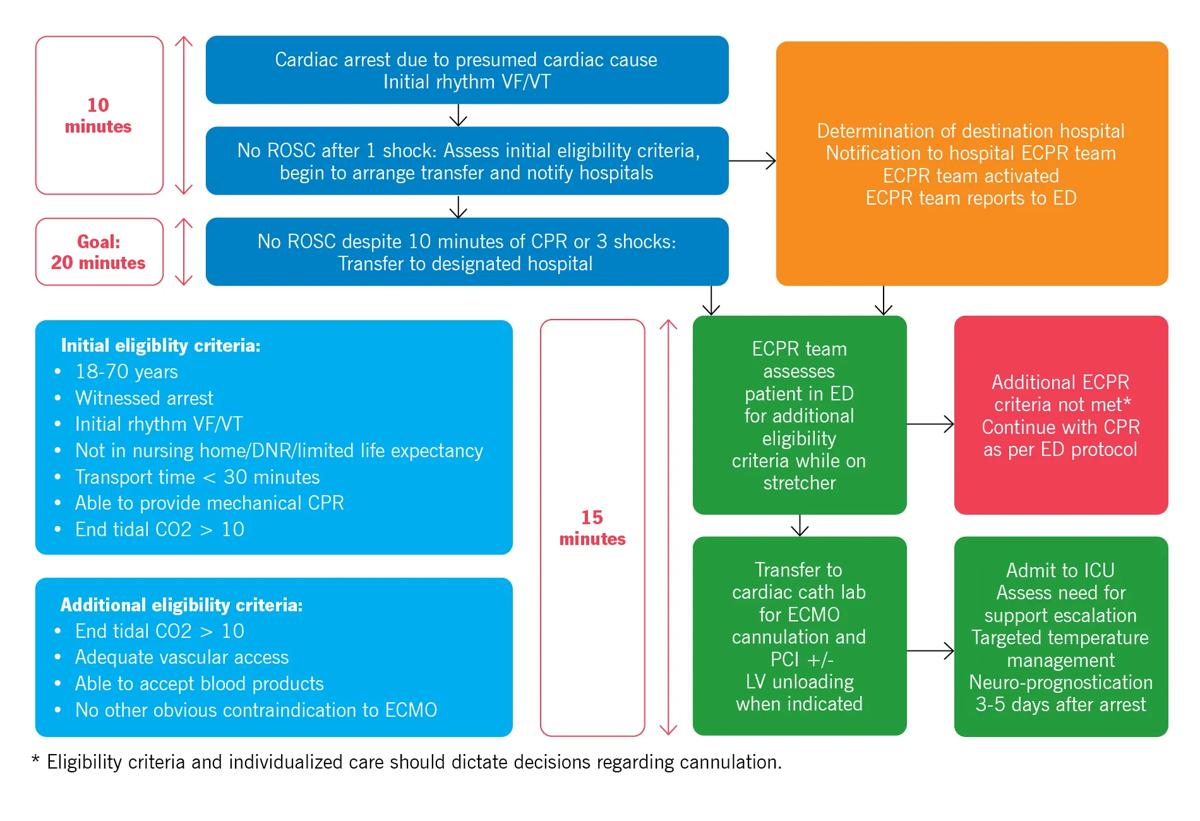
Image content: This image is available to view online.
View image online (https://assets.clevelandclinic.org/transform/3fba4f9d-6d8e-48b3-b7ff-7b9738018b5a/ecpr-flow-chart)
Figure. Schematic of the initial workflow for the ECPR program, which undergoes continual refinement.
For instance, continuous quality assessment since the ECPR program’s launch in January 2026 has already led to a few process changes. Most notable is the site of cannulation. Initially, arriving patients underwent rapid point-of-care testing in the ED before being transported to the cardiac catheterization lab for cannulation. However, this transport added up to 10 minutes of critical low-flow time. To eliminate this delay, Cleveland Clinic is transitioning primary ECPR cannulation directly into the ED, starting with acquisition of a dedicated fluoroscopy table for the ED resuscitation suite. Under this evolving workflow, cath lab nurses, perfusionists and the designated cannulator report directly to the ED.
“Our cath lab nurses are going down to the ED to support ECMO cannulation,” Dr. Tamis-Holland observes. “That type of engagement across units is essential.”
Rather than creating an isolated single-hospital ECPR protocol, Cleveland Clinic collaborated with local EMS providers and another local academic health center to establish a unified regional system. Supported by a grant from the Mandel Foundation, the initiative — known as the Cleveland ECPR Program — focuses on citywide standardization of timely care for refractory OHCA.
Advertisement
Prehospital protocols, including the patient eligibility criteria described above, were developed in conjunction with EMS medical directors. “Local EMS were already transporting OHCA patients, of course, but there wasn’t a detailed protocol specific to the care and transport of these patients with refractory arrest,” Dr. Tamis-Holland explains.
The program maintains active engagement with local EMS and the Cleveland community, providing regular feedback to paramedic squads and hosting educational events to raise awareness of the service. It aims to integrate prehospital CARES (Cardiac Arrest Registry to Enhance Survival) data with in-hospital registries to facilitate continuous quality monitoring and debriefing. “The only way to succeed is by constantly monitoring prehospital data and working in close partnership with EMS,” Dr. Tamis-Holland says.
Although Cleveland Clinic’s Main Campus and the other academic center are presently the only two hospitals participating in the program, plans call for eventual expansion to other Cleveland Clinic hospitals in or close to Cleveland city limits. “What’s special about this program is its hyperlocal focus -- the fact that it’s specific to our neighbors here in Cleveland,” says Dr. Soltesz. “It’s great to offer this critical service to address an unmet need in our community.”
Advertisement

Takeaways from the most recent annual meeting centered around clinical advances, AI integration and professional development
The progressive training program aims to help clinicians improve patient care
ECMO specialists partner with ethicists to guide fellow caregivers in critical decision-making
Study underscores the magnitude of stroke in pediatric ECMO patients
For severe cases, complete unroofing of the bridge is imperative

Helping pediatricians and families make safer, more individualized activity decisions
Heart Rhythm Society calls for nationwide CPR and AED education for high school students
Even seemingly healthy athletes can be at risk for SCD, making prevention a complex challenge
 Search