Locations:





For severe cases, complete unroofing of the bridge is imperative
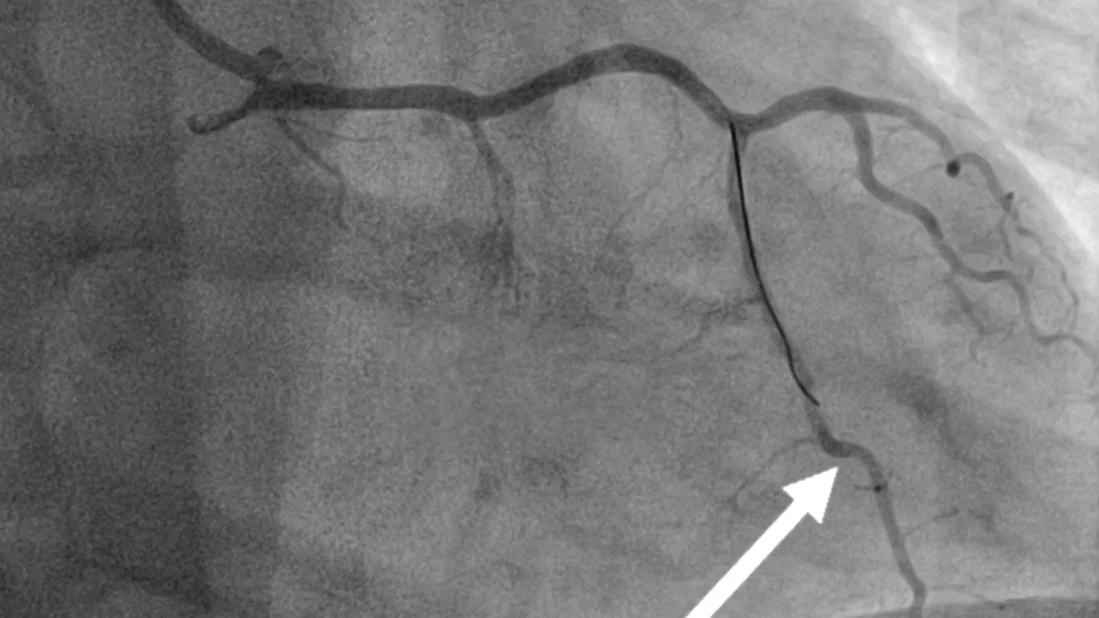
Image content: This image is available to view online.
View image online (https://assets.clevelandclinic.org/transform/5c185e82-bf48-4933-836d-b9f18b2ccb2b/myocardial-bridge-crop)
scan of a blood vessel with white pointing arrow
Myocardial bridges — sections of coronary artery that travel within the myocardium, leading to constricted blood flow when the heart is in systole — are estimated to be present in as many as 30% of the population. While usually benign and asymptomatic, this congenital condition in some situations requires complex surgical solutions to alleviate symptoms such as chest pain and shortness of breath and help prevent cardiac events, including sudden death.
Advertisement
Cleveland Clinic is a non-profit academic medical center. Advertising on our site helps support our mission. We do not endorse non-Cleveland Clinic products or services. Policy
“Management of myocardial bridges depends on multiple clinical and anatomic factors,” says Joanna Ghobrial, MD, MSc, Medical and Interventional Director of Cleveland Clinic’s Adult Congenital Heart Disease Center. “Because myocardial bridges are so common, an incidental finding may not warrant complete investigation or treatment. But if a patient has cardiac symptoms or an anomalous aortic origin of the coronary artery (AAOCA) is present, a thorough evaluation is needed.”
Initial investigation of symptomatic patients or of individuals incidentally discovered to have myocardial bridges consists of noninvasive exercise or pharmacological stress testing to define the physiologic effect of the bridge, as well as coronary CT angiography to define the coronary artery origin and its course along with the number, length and depth of bridges.
When symptoms and the stress test result are discordant, invasive evaluation can better characterize the bridge’s hemodynamic effect. During cardiac catheterization and coronary angiography, a pressure wire is used to measure the instantaneous wave-free ratio (iFR) to assess for ischemia and intravascular ultrasound (IVUS) is performed to further delineate bridge depth, vessel area, concomitant plaque burden and other anatomical features.
“After we have gained a thorough understanding, we take a multidisciplinary approach — including consultation among cardiologists, surgeons and interventionalists — to determine the best treatment strategy,” Dr. Ghobrial explains.
Advertisement
Also important, she adds, is consideration of a patient’s needs and circumstances, such as age, activity level and occupation. Athletes, pilots, firefighters and others at highest risk for sudden death may require a lower threshold for intervention/surgery.
In some cases, prescribing medications such as beta-blockers or calcium channel blockers to treat mild ischemia and symptoms may suffice. For others, surgical solutions are needed.
For uncomplicated cases — those with easily accessible bridges — simple surgical myotomy, known as “unroofing” of myocardial bridges, is often advised to free the constricted artery. These cases most commonly involve only the left anterior descending artery (LAD).
The rare congenital defect of AAOCA involves myocardial bridges in some 20% to 40% of cases. The left coronary artery tends to not only have an anomalous origin but may take a transseptal or intraventricular course (Figure 1), requiring a more complex operation to accomplish unroofing.
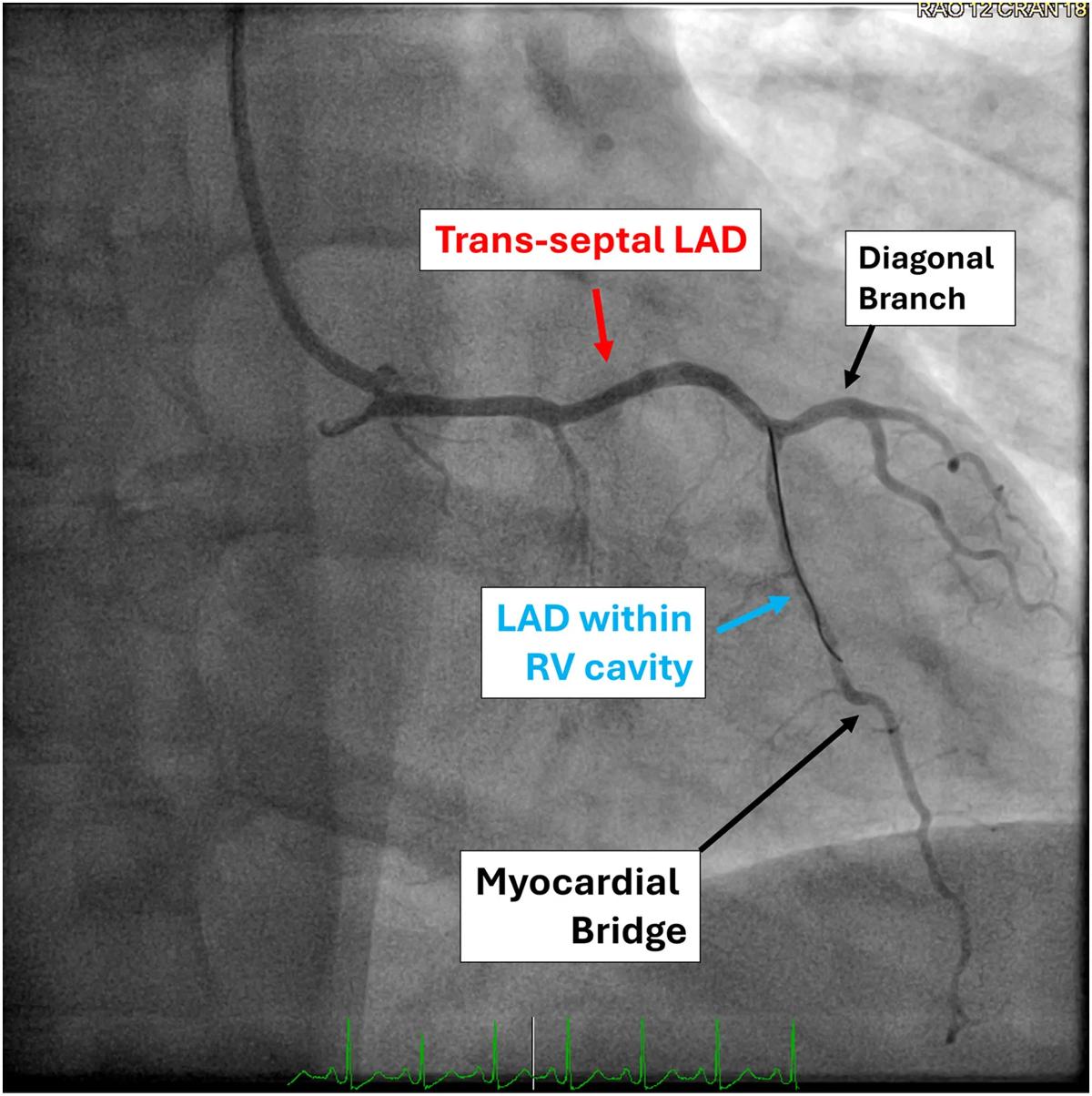
Image content: This image is available to view online.
View image online (https://assets.clevelandclinic.org/transform/6f048210-e715-43a1-96d7-70b222c90470/myocardial-bridge)
Figure 1. Coronary angiogram showing an anomalous LAD with a transseptal and intracavitary course. The LAD originates from the right coronary artery and traverses the interventricular septum, entering the right ventricular (RV) cavity before reemerging on the anterior surface. A distinct myocardial bridge segment is visualized distally. Reprinted under the CC BY 4.0 license from Farahi et al., JTCVS Tech. 2026;35:102157. Copyright ©2025 The Authors.
To address this situation, Hani Najm, MD, Chair of Pediatric and Congenital Heart Surgery at Cleveland Clinic, developed a transconal unroofing technique also known as the Najm procedure. It involves opening up the right ventricle, exposing the course of the right coronary artery, and proceeding to free it. Autologous pericardium is used to close gaps internal or external to the repair, as needed. The operation is now being adopted by other centers.
Since the publication of initial reports summarizing Cleveland Clinic’s experience with surgical solutions to AAOCA and myocardial bridges in 14 adults (covered in previous Consult QD articles here and here), Dr. Najm reports that his team has been operating on increasingly complicated cases with arteries following different courses. They most recently reported on a case of LAD exteriorization with an intraventricular course (JTCVS Tech. 2026;35:102157) (Figure 2).
Advertisement
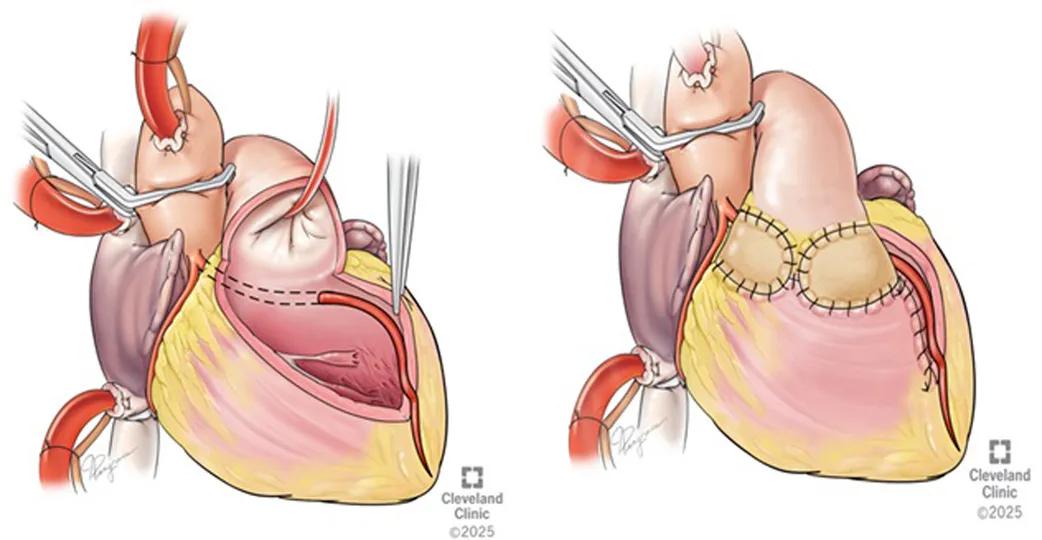
Image content: This image is available to view online.
View image online (https://assets.clevelandclinic.org/transform/3cf943f4-1100-40f1-af83-c47a084f742d/transconal-unroofing)
Figure 2. Essentials of the Najm transconal unroofing procedure with LAD exteriorization from the recent case report. (Left) Illustration of the anteriorly opened right ventricular outflow tract (RVOT) and the appearance of the LAD underneath the septal muscle and running within the cavity of the right ventricle to the apex. The dotted lines indicate the planned incision line to unroof the LAD. The coronary segment was unroofed throughout the entire intraseptal area. The unroofing was extended distally to the apex as it emerged. (Right) Illustration of the completed repair, with the anterior RVOT closed with a patch of autologous pericardium and the LAD entirely exteriorized. Reprinted under the CC BY 4.0 license from Farahi et al., JTCVS Tech. 2026;35:102157. Copyright ©2025 Cleveland Clinic.
Dr. Najm says the team has now performed the transconal unroofing procedure on close to 30 patients and will publish an updated review soon.
“Regardless of complexity, we have had success following the same basic formula: Follow the artery, free the artery and close the space with a pericardial patch,” he reports. “No matter the depth, the bridge needs to be completely unroofed.”
He adds that he is available for surgical consultation on the procedure and that appropriate patients can be referred to Cleveland Clinic for care.
Patients with atherosclerosis may need coronary artery bypass surgery (CABG) in addition to myocardial bridge unroofing. Previously, bypass was the classic procedure for dealing with myocardial bridges, but Dr. Najm stresses that it is absolutely the wrong solution for this problem alone, as competitive flow and subsequent graft failure tend to result in suboptimal outcomes. He adds that many patients are referred to Cleveland Clinic who have undergone CABG inappropriately in this context and need further intervention.
Coronary artery stenting is not recommended for bridges or AAOCA, due to a high risk of stent failure and future complications.
Patients who are found to have coronary vasospasm or microvascular disease are referred to an expert on these problems following unroofing surgery.
Regardless of the type of unroofing surgery, patients are again thoroughly assessed at six months with IVUS and iFR to evaluate resolution or improvement of ischemia and, if appropriate, can be cleared for unrestricted activity.
Advertisement
“To my knowledge, we are the only center to have patients undergo the postoperative invasive testing for routine follow-up,” Dr. Ghobrial says. “But we feel it is critical for demonstrating success of the surgery, indicating reduced risk of a cardiac event. Most of our patients certainly feel better at this point.”
She adds that all patients require longitudinal follow-up to address any residual or new symptoms.
Advertisement
Advertisement
Heart Rhythm Society calls for nationwide CPR and AED education for high school students

Even seemingly healthy athletes can be at risk for SCD, making prevention a complex challenge

Consortium makes key recommendations to improve prevention practices
Guidance on the often-fatal condition through an interventional cardiology lens
Collaborative citywide initiative reshapes protocols to boost cardiac arrest survival

Helping pediatricians and families make safer, more individualized activity decisions

Maintain a high index of clinical suspicion and consider the underlying etiology
A reliable and reproducible alternative to conventional reimplantation and coronary unroofing
 Search