Locations:





Patient had tenolysis and fasciectomy but sympoms recurred
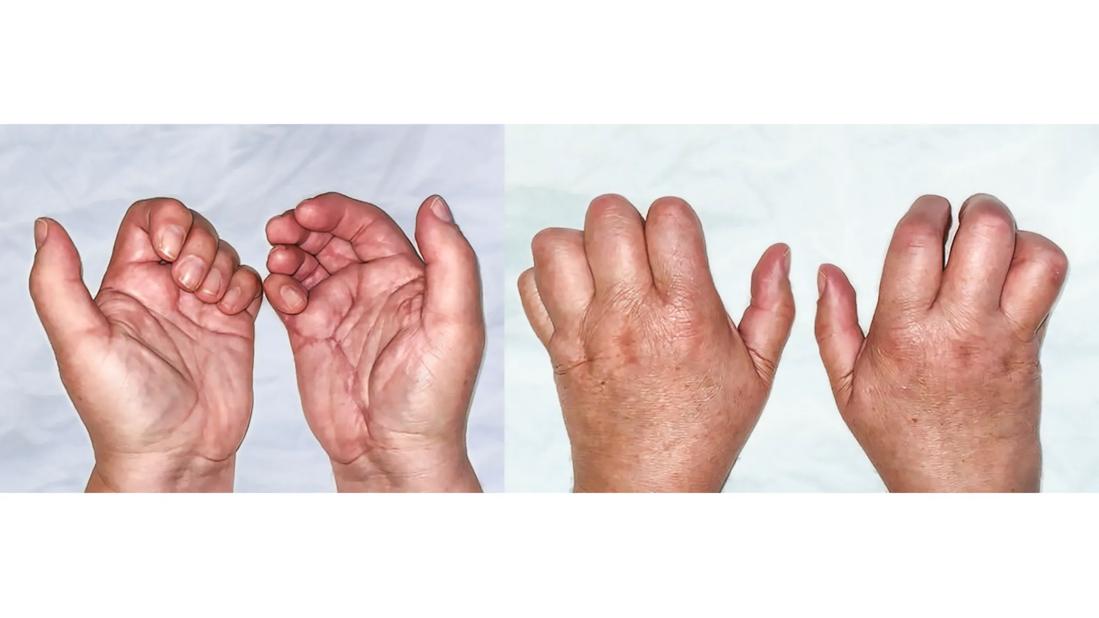
Image content: This image is available to view online.
View image online (https://assets.clevelandclinic.org/transform/09b2d0f4-a754-48b4-98dd-10ae0dc2a988/painful-hand-swelling-brown)
swollen hands
Advertisement
Cleveland Clinic is a non-profit academic medical center. Advertising on our site helps support our mission. We do not endorse non-Cleveland Clinic products or services. Policy
A 56-year-old woman with no history of rheumatic disease or hand injury presented to the rheumatology clinic with bilateral hand contractures. Fifteen months prior, she developed sudden onset of severe bilateral hand pain, swelling and stiffness, which progressed to bilateral finger contractures over the next few weeks. Six months later, she underwent tenolysis and fasciectomy for her right (dominant) hand, but the contracture recurred within six months. Ibuprofen did not improve her hand pain, so she received prednisone (30 mg daily) and methotrexate (10 mg weekly), which partially relieved her pain but resulted in a 6.8-kg (15-pound ) weight gain. Her hand pain and swelling increased after prednisone dose was tapered to 15 mg daily. Methotrexate was increased to 20 mg weekly but stopped after two months due to leukopenia.
In the rheumatology clinic, physical examination revealed swelling and tenderness of wrists, metacarpophalangeal and proximal interphalangeal joints, nodular palmar tendon thickening, and flexion contractures of all fingers. Laboratory studies revealed a normal complete blood cell count and differential, comprehensive metabolic panel, erythrocyte sedimentation rate, and C-reactive protein level. Results of tests for rheumatoid factor, antinuclear antibody, as well as antibodies to cyclic citrullinated peptide, extractable nuclear antigens, and double-stranded DNA, were negative.
Hand radiographs showed mild interphalangeal joint spurring; ultrasound with color flow Doppler revealed hypervascularity and synovial thickening in several metacarpophalangeal and proximal interphalangeal joints but no joint effusions or tenosynovitis. Results were normal for serum and urine immunofixation electrophoresis, cancer antigen 125 (CA-125), cancer antigen 19-9 (CA 19-9), carcinoembryonic antigen (CEA), pelvic ultrasound, CT (chest, abdomen, pelvis), mammography, upper endoscopy and colonoscopy.
Advertisement
Given the information available at this point, consider possible next steps. (See correct option at the end of the article.)
A. Arrange a whole-body PET-CT scan.
B. Obtain a three-phase bone scan.
C. Order anti-RNA polymerase III antibody testing.
D. Perform a full-thickness skin biopsy.
The patient was diagnosed with palmar fasciitis with polyarthritis syndrome (PFPAS). PFPAS is a rare paraneoplastic rheumatic disorder characterized by sudden, painful, symmetric bilateral hand swelling and stiffness.1 Thickening and induration of the palmar fascia often lead to finger flexion contractures over weeks to months. The characteristic clinical manifestations of PFPAS are likely caused by tumor-derived cytokines or growth factors that activate fibroblasts in palmar and periarticular tissues.1
Histological findings on biopsy include fibroblastic proliferation, perivascular inflammation and fibrotic changes in the palmar fascia.1,2
Since its first description in 1982,3 more than 100 cases of PFPAS have been reported.1,4 PFPAS typically presents in the sixth to seventh decade and affects women at least four times more often than men.1,4 It appears by a median of four to six months before the diagnosis of malignancy 1,4 and is most commonly associated with the following cancers: ovarian (36.8%), gastrointestinal (19.6%), other gynecologic (12.4%), breast (9.2%), lung (6.9%), and hematolymphoid (4.6%).1 In fewer than 5% of cases, PFPAS occurs in patients without cancer 5-7 and is classified as idiopathic.1,4 The differential diagnosis of PFPAS includes Dupuytren’s contracture, systemic sclerosis, rheumatoid arthritis, eosinophilic fasciitis, complex regional pain syndrome, pseudogout, fibroblastic rheumatism and remitting seronegative symmetrical synovitis with pitting edema.1
Advertisement
Patients being evaluated for PFPAS should undergo screening tests for occult malignancy, including pelvic ultrasound, mammography, contrast-enhanced abdominal CT scan, upper endoscopy and colonoscopy. Tumor markers, including CA-125, CA 19-9, CEA, and prostate-specific antigen, can also aid in the diagnosis of malignancy.1,2,8,9 Early identification and treatment of the underlying malignancy improve patient outcomes.4
After treatment with chemotherapy and/or surgical resection, patients with PFPAS often have resolution of their hand pain and swelling within weeks to months, and finger contractures stop progressing.1,2,10 Glucocorticoids (e.g., prednisone, 10-20 mg daily) may alleviate joint pain and swelling; however, their effectiveness varies.1,4 Conventional disease-modifying antirheumatic drugs, such as hydroxychloroquine, methotrexate and sulfasalazine, have an overall response rate of approximately 43%.4 Surgical treatment of finger contractures in patients with PFPAS is not routinely recommended.
A whole-body PET-CT scan revealed a 1.7 cm hypermetabolic aortocaval lymph node. Due to its small size, retroperitoneal location and stable appearance on follow-up CT scans at six and 20 weeks, close surveillance was initially planned. However, six months later, a CT scan revealed enlargement of the aortocaval lymph node to 2.1 cm × 2.4 cm. A CT-guided core biopsy of the lymph node showed metastatic carcinoma consistent with a gynecologic primary based on morphology and immunohistochemistry. About five weeks later, the patient underwent a total abdominal hysterectomy, bilateral salpingooophorectomy, aortic lymph node debulking and omentectomy. Pathology confirmed the diagnosis of stage 3 high-grade serous carcinoma of the right fallopian tube with metastasis to one of four aortic lymph nodes and no peritoneal involvement. She completed six cycles of chemotherapy with carboplatin and paclitaxel. After the first cycle of chemotherapy, her hand pain and swelling resolved. At five-year follow-up, the patient’s cancer was in remission, and she was not taking any immunosuppressive medications. Her hand pain and swelling had not recurred. Her finger contractures persisted but had not progressed.
Advertisement
The correct diagnostic test is: A. Arrange a whole-body PET-CT scan. The key to the correct diagnosis is recognizing that painful hand swelling, palmar fascial thickening and finger contractures with negative results of serologic testing for autoimmune rheumatic diseases suggest PFPAS, a rare paraneoplastic syndrome. A three-phase bone scan (choice B) is not recommended because complex regional pain syndrome is unlikely without hand trauma. An anti-RNA polymerase III antibody test (choice C) is not indicated because the patient did not exhibit proximal skin thickening or Raynaud’s phenomenon, which are characteristic of systemic sclerosis. A full-thickness skin biopsy (choice D) helps diagnose eosinophilic fasciitis; however, that condition is unlikely without eosinophilia and proximal skin thickening.
This article was originally published in JAMA 2025 Dec 2;334(21):1943-1944.
1. Manger B, Schett G. Palmar fasciitis and polyarthritis syndrome—systematic literature review of 100 cases. Semin Arthritis Rheum. 2014;44(1):105-111.
2. Martorell EA, Murray PM, Peterson JJ, Menke DM, Calamia KT. Palmar fasciitis and arthritis syndrome associated with metastatic ovarian carcinoma: a report of four cases. J Hand Surg Am. 2004;29(4):654-660.
3. Medsger TA, Dixon JA, Garwood VF. Palmar fasciitis and polyarthritis associated with ovarian carcinoma. Ann Intern Med. 1982;96(4):424-431.
4. Ma X, Li XY, Wang JW, Ma DL. Update on palmar fasciitis and polyarthritis syndrome: a systematic review. Joint Bone Spine. 2025;92(1):105776.
Advertisement
5. Laszlo KS, Falanga V, Kerdel FA. Idiopathic palmar fasciitis. Int J Dermatol. 1995;34(9):658-660.
6. Seaman JM, Goble M, Madsen L, Steigerwald JC. Fasciitis and polyarthritis during antituberculous therapy. Arthritis Rheum. 1985;28(10):1179-1184.
7. Sung YK, Park MH, Yoo DH. Idiopathic palmar fasciitis with polyarthritis syndrome. J Korean Med Sci. 2006;21(6):1128-1132.
8. Badawy M, Revzin MV, Consul N, et al. Paraneoplastic syndromes from head to toe: pathophysiology, imaging features, and workup. Radiographics. 2023;43(3):e220085.
9. Naschitz JE, Rosner I, Rozenbaum M, Zuckerman E, Yeshurun D. Rheumatic syndromes: clues to occult neoplasia. Semin Arthritis Rheum. 1999;29(1):43-55.
10. Enomoto M, Takemura H, Suzuki M, et al. Palmar fasciitis and polyarthritis associated with gastric carcinoma: complete resolution after total gastrectomy. Intern Med. 000;39(9):754-757.
Advertisement
Best practices in a changing landscape
Case: Presentation includes joint pain and neurological symptoms

Evidence suggests empathy influences immune function and well-being
Going beyond simple referrals to streamline patient access

Tracing our understanding of this complex systemover more than a century

Drug-free remission holds more than a year after treatment

Cleveland Clinic group works toward earlier diagnosis of this rare disease
Researching the biological basis for why treatment is or is not effective
 Search