Locations:





Neurotology and neurosurgery specialists outline collaborative strategies for preserving function and tailoring treatment
Podcast content: This podcast is available to listen to online.
Listen to podcast online (https://www.buzzsprout.com/2241209/19360350)
When it comes to skull base tumors, multidisciplinary collaboration between neurotology and neurosurgery is essential.
Advertisement
Cleveland Clinic is a non-profit academic medical center. Advertising on our site helps support our mission. We do not endorse non-Cleveland Clinic products or services. Policy
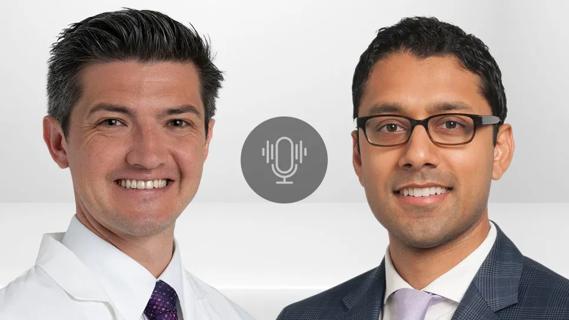
A recent episode of Head and Neck Innovations offers insights from experts in neurotology and neurosurgery on the differences between how the two specialties approach diagnosis and management of lateral skull base tumors.
“Patients sometimes present to Anh Nguyen-Huynh, MD, who is an otolaryngologist specializing in neurotology in ENT, or they can present to me in neurosurgery,” explains Pranay Soni, MD, a neurosurgeon specializing in skull base, brain tumor and spine tumor surgeries. “Oftentimes it's the symptoms that dictate that, whether it's more the hearing or balance type symptoms or more the neurologic symptoms.”
Dr. Soni says that the most common pathology he sees is vestibular schwannoma, as well as meningiomas and paragangliomas.
“The most common presenting symptoms I see are either sudden hearing loss or hearing loss that's progressive but significantly worse on one side,” says Dr. Nguyen-Huynh. “These patient often comes to the ENT to have evaluation, and as part of that evaluation, we often include an MRI to look at the inner ear and the auditory nerves. That's how we pick up these tumors, and I would say that far and away is the most common reason for patients to show up at our door.”
Both specialists note that while MRI is typically the most common diagnostic tool, workup is tailored to symptoms and tumor anatomy. For example, audiograms are also obtained for nearly every patient, but CT may be used to evaluate bony structures.
“Many of the tumors that we deal with are actually benign,” explains Dr. Nguyen-Huynh. “So observation is a very reasonable option, especially since data have shown it gives the best short-term outcome in terms of preserving function the way they are in the patient at presentation. But as the tumor progresses, which we can see through a serial imaging study, of course, other treatment modalities will be discussed.”
Advertisement
When it comes to treatment, patient goals and preferences remain central to the care strategy.
“A patient may have a preference to treat a tumor earlier because it causes significant anxiety or the risk that it poses down the road may be important to them,” says Dr. Soni. It's important to have that conversation, and it's a combined collective decision that involves the multidisciplinary team, but also the patient, their family and what their preferences are.”
Multidisciplinary collaboration is a defining feature of care at Cleveland Clinic. Dr. Nguyen-Huynh and Dr. Soni both describe a team-based approach to skull base tumors that includes specialists from neurotology and neurosurgery, along with other specialties.
“One of the nice things about working in the team here is that our colleagues, Dr. Soni and other are well-versed in all of the treatment modalities,” says Dr. Nguyen-Huynh. “They are not engaged in just one modality of treatment and unfamiliar with others. So they're able to present very balanced views of the pros and cons.”
Click the podcast player above to listen to the episode now, or read on for a short, edited excerpt. Check out more Head and Neck Innovations episodes at clevelandclinic.org/podcasts/head-and-neck-innovations or wherever you get your podcasts.
Podcast host Paul Bryson, MD, MBA: It sounds like preserving function, hearing preservation, facial nerve function, quality of life are really important conversations. Can you speak a little bit to the balance that you try to strike, but also some of the surgical approaches that you might entertain for those patients that might be surgical candidates?
Advertisement
Dr. Nguyen-Huynh: We offer observation with serial imaging, stereotactic radiation therapy, as well as surgical resection. And when we go on the route of surgery, we pursue all possible venues depending on the location, tumor-involved structures and a specific anatomical variation on any particular patient.
One nice thing about our working relationship here at the Cleveland Clinic is that we are comfortable with many approaches and some fairly innovative ones as well as the traditional ones. We will tailor our treatment to the patient's goals and the feasibility of complete resection or not and the risk to the various structures. So, these conversations are taking place among our team with the patient foremost in mind and without any particular agenda as to whether we should be doing this one because that's the one I'm more comfortable with or whether we're doing this one because it's going to benefit us in any way, but we do take care of our patient and put that front and foremost.
We have these discussions, and when we see the patient, if one of us sees the patient for the first time, we always say we're going to make our decision based on treatment after consultation with our colleague and discussions. We will communicate that clearly with the patient so they will understand our reasoning behind that and be part of the decision.
Dr. Bryson: Is there a tumor board structure as we see with some of our colleagues in head and neck oncology? Is there a skull base tumor board as well?
Advertisement
Dr. Soni: Yeah, actually we have a few tumor boards. We have a brain tumor board, which can discuss tumors such as schwannomas, meningiomas, paragangliomas, but we actually have dedicated tumor boards as well. We have a skull base conference where we can discuss complex cases. And then we also have a neurofibromatosis and schwannomatosis tumor board that meets once a month and involves the multidisciplinary team members. So, there are a lot of different avenues for that multidisciplinary discussion.
Dr. Bryson: I know tumor boards aren't unique around the country, but I do feel like the spirit of collaboration here at Cleveland Clinic seems to happen pretty naturally between our specialties and some of the other specialties. Dr. Nguyen-Huynh, you were alluding to this, and it's just a really nice way for people to come together with the best interests of the patient in mind. I wanted to change gears a little bit here as maybe we kind of wrap up a little, but it's such a dynamic, very complex space. You both alluded to a little bit of the innovation that may be happening in this area. Can both of you speak to emerging technologies or innovations and advances in the management of these pathologies?
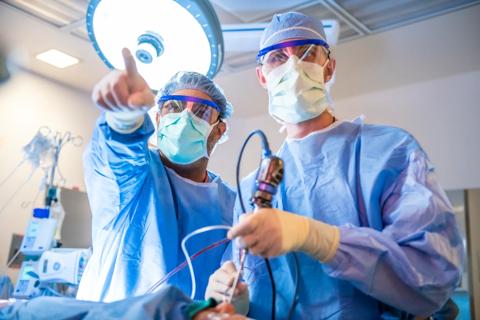
Dr. Soni: I can highlight a couple of those. In the operating room, one of the newest technologies that we use is called an exoscope, which is similar to a microscope that's been used for decades, but it allows better illumination, better visualization of structures and really allows us to work more efficiently in the operating room.
Advertisement
So that's one of the newest technologies that we've been employing, but there have been improvements in navigation techniques in the operating room with better accuracy. We continue to use different monitoring techniques as well to help us monitor those nerves that we talked about to preserve things like hearing and facial nerve function and vocal cord function. All of those are techniques and technologies that we use in the operating room. And then from the standpoint of other treatment modalities, we've continued to kind of modify the radiation strategies using GammaKnife, which is a type of stereotactic radiosurgery.
We've changed our dosing to help preserve things like hearing, minimize side effects from radiation and improve tumor control. So that's continuing to evolve as well.
Advertisement
Early identification of temporal encephaloceles can improve surgical decision-making
Two cases show how integrated surgical and prosthodontic planning is necessary for dental rehabilitation of major maxillary defects
How effective management integrates multiple specialties and therapies
Systematic review indicates more can be done for higher-risk patients
Analysis of HNSCC patients shows HPV status to be predictive of higher abundance of oncobacteria within the tumor

Case study illustrates the potential of a dual-subspecialist approach
Evidence-based recommendations for balancing cancer control with quality of life
Study shows no negative impact for individuals with better contralateral ear performance
 Search