Locations:





Initiative provides hands-on opportunities to promote early, progressive activity
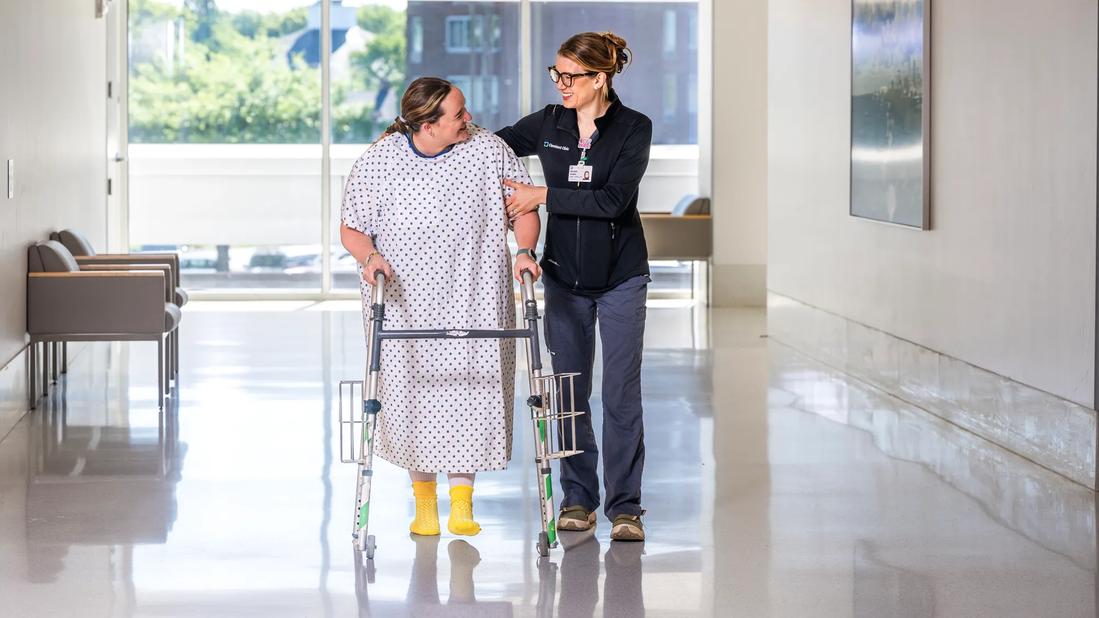
Image content: This image is available to view online.
View image online (https://assets.clevelandclinic.org/transform/326d25ae-394b-412a-acd8-672b0f786811/NUR_9011908_8-18-26_002_MLC)
Racheal Jividen helping patient mobilize
For critically ill patients, mobility can be a powerful marker of progress. But even when patients are physically capable of achieving a higher level of activity, competing clinical priorities, high patient acuity, staffing challenges and limited mobility education can stand in the way.
Advertisement
Cleveland Clinic is a non-profit academic medical center. Advertising on our site helps support our mission. We do not endorse non-Cleveland Clinic products or services. Policy
A nurse-led quality improvement project at Cleveland Clinic was designed to help close that gap by giving nurses dedicated time and responsibility to focus on patient activity. The hands-on program paired dedicated nurses – Mobility Champions – with physical therapists to help patients in the intensive care unit (ICU) safely reach their goals.
“We do a disservice to our patients when we save their life but discharge them deconditioned and unable to resume ‘normal’ activities,” explains Rachael Alexis Jividen, DNP, APRN-CNS, ACCNS-AG, CCRN-CSC-CMC, an acute care clinical nurse specialist at Cleveland Clinic Hillcrest Hospital. “Unfortunately, it can be especially difficult to mobilize patients to their maximum potential in the ICU because of the sheer number of resources required, both human and material, and the time it takes to get patients out of bed. That’s where our Mobility Champions come in.”
Jividen, who led the proof-of-concept program in the cardiovascular ICU at Cleveland Clinic’s Main Campus, has witnessed patients receiving extracorporeal membrane oxygenation (ECMO) and mechanical ventilation walk the halls — and even visit the hospital rooftop — as part of their recovery. She says those experiences have reinforced her belief that mobility should be viewed as a priority for all patients, not only those who require intensive physical therapy (PT).
“The patients reported experiencing an elevated mood when they were liberated from the ICU and walked the halls of their unit,” she notes. “I realized that if we could walk patients on ECMO, we could mobilize just about anyone.”
Advertisement
The consequences of immobility can extend well beyond a patient’s ICU stay. Prolonged inactivity and ICU-acquired weakness can contribute to physical and cognitive impairments, deconditioning and complications that affect recovery long after discharge. Jividen emphasizes that early, progressive activity can help reduce risks such as falls, pressure injuries, delirium and venous thromboembolism while supporting functional recovery and the ability to return home after hospitalization.
Although patients with the most complex needs often receive substantial support from PT and other clinicians, patients who require less assistance may be overlooked. Jividen stresses that a dedicated mobility team can help identify patients who are ready to move and determine the safest level of activity, allowing nurses and other caregivers to begin interventions without unnecessary delays.
Although their roles overlap, Mobility Champions and nurses performed distinctly different functions.
“Our goal was to preserve the role of the primary nurse,” Jividen says. “Champions do not replace bedside caregivers. They are there to provide additional expertise and hands-on support while helping their colleagues integrate movement into the daily plan of care.”
Mobility Champions partner with physical therapists at the beginning of their shift to identify and establish an individualized plan for patients who require mobilization. They also use a validated scoring tool to predict the highest level of mobility a patient is expected to achieve based on clinical and functional status.
Advertisement
The nurse champion then rounded on patients, documented daily activity goals, assisted primary nurses with mobility interventions and educated patients, families and caregivers about the benefits of early progressive activity.
Jividen says the program also provided a framework for measuring progress. Champions supported documentation of mobility events, shared recommendations with members of the nursing team, and completed a summary tool that enables leaders to track activity levels and identify opportunities for improvement.
She explains this peer-to-peer model can be particularly valuable in high-acuity environments, where nurses may hesitate to advance a patient’s mobility when they are unfamiliar with the techniques or uncertain about what an individual can safely accomplish.
Jividen notes the model’s encouraging results. The results of the quality improvement project revealed that Mobility Champions consistently exceeded patients’ predicted mobility levels, suggesting that repeated experience and focused education may help nurses become more comfortable facilitating higher levels of mobility in the ICU.
“This finding was particularly exciting because it shows that prioritizing movement can help organizations overcome barriers and sustain improvement,” she says.
Despite the program’s success, Jividen cautions that no single mobility model will work for every hospital. Staffing, patient acuity, available PT resources and local patient populations all influence how such programs should be structured. However, she stresses that nurses are uniquely positioned to identify barriers to mobility and develop practical solutions.
Advertisement
By combining sound clinical judgment, multidisciplinary expertise, standardized assessments and opportunities for facilitating activity, Jividen says mobility programs can help nurses build confidence while making progressive movement more visible and achievable for patients.
“Nurses are uniquely positioned to start conversations about mobility,” she adds. “With the right education, structure and support, nurses can become powerful catalysts for a culture in which getting patients moving is not an extra task, but an essential part of critical care.”
Advertisement
Advertisement
Using meticulous preparation and teamwork to manage critically ill patients in constantly changing environments

Translating clinical questions into meaningful, sustainable change
Guidance for creating a relevant framework that reflects organizational values, supports professional practice

Helping patients recognize respiratory changes, navigate treatment barriers and stay connected to their clinical team

Continuing to grow by following the right path at the right time

Teaching caregivers to recognize warning signs, de-escalate difficult situations and maintain professional boundaries

Veteran caregivers offer practical wisdom for building confidence and practicing with purpose
Skill, dedication and a passion for women and children inspire this joy-filled specialty
 Search